Having given decades working with Australia’s mining industry, Australian Pump Industries have learned a lot. Not just about how essential the industry is to the economy, but we also learned about what goes on in the field particularly with corrosive and abrasive liquids. Australian Pumps Chief Engineer John Hales, reveals the massive high-speed program that the company has carried out in order to bring 316 stainless steel pumps to the industry, at reasonable prices.
It was Aussie Pump’s experience with the heroes of the drilling industry that got the team really thinking about 316 stainless steel as a formidable material for corrosive mining applications.
Although some of our team, particularly Warwick Lorenz, Managing Director, had cut his teeth 40 years ago with Pacific Pump building deep well submersible pumps in Australia. In those days, the company was building pumps with locally made, cast iron-nickel-aluminium-bronze and 316 stainless steel.
Big multi-stage pumps went into applications like the coal mines, in the Hunter Valley and Queensland, Alice Springs Water Supply, Gladstone Alumina Refinery and lots of other applications. Many of those old Australian built plunger pumps are still out there.
Thanks to the drillers
Problem solving is in Aussie Pumps’ DNA, whether the issues be agricultural, climate-related or regarding the liquid being pumped. The team has no problem with nickel-aluminium-bronze pumps for marine applications, including many of those that they’ve supplied to the Royal Navy for surface vessels.
When it comes to mining, it was the drilling industry who came to us having compared our aluminium, cast iron and in some cases polyester pumps to some of the cheap third world products that were sold “as throwaways”. Even throwaways can be expensive, particularly if they happen to break down, when reliability and continuity is essential.
Australasian Drilling
Australasian Drilling first introduced us to the mud pump project and guided us through the materials. They bought big 3” heavy-duty self-priming centrifugal pumps, hydraulically driven, but insisted on nickel aluminium, bronze material for the pump bowl and impellers. It taught us a lot, and we learnt fast by word getting out to other drilling contractors and drill manufacturers who could see that we had the right idea — but we were drowning in our own ignorance of the application.
Stainless Steel Impellers
The drillers showed us that cast iron impellers didn’t last, and often mechanical seals failed too. Mechanical seals were invariably being run dry and the cast iron impellers in our original mud pump package were too soft for the application. It couldn’t take the abrasive nature of the of the liquid being pumped.
Our response was to start putting the 316 stainless impellers and tungsten carbide mechanical seals in the pumps that were being shipped to the drillers. The spare parts sales started to slide down and that gave us a good idea that we were on the right track.
We talk to drillers
It was talking to the maintenance superintendent on a drill rigg site out in Woomera, who gave us the idea of, instead of just putting stainless steel in some impellers in the pump, why not to go all the way and 316 cast the bodies of the pump as well. On that basis, the pump may have to have some parts replaced over a period of time, but one thing’s for sure, the body itself will never wear out!
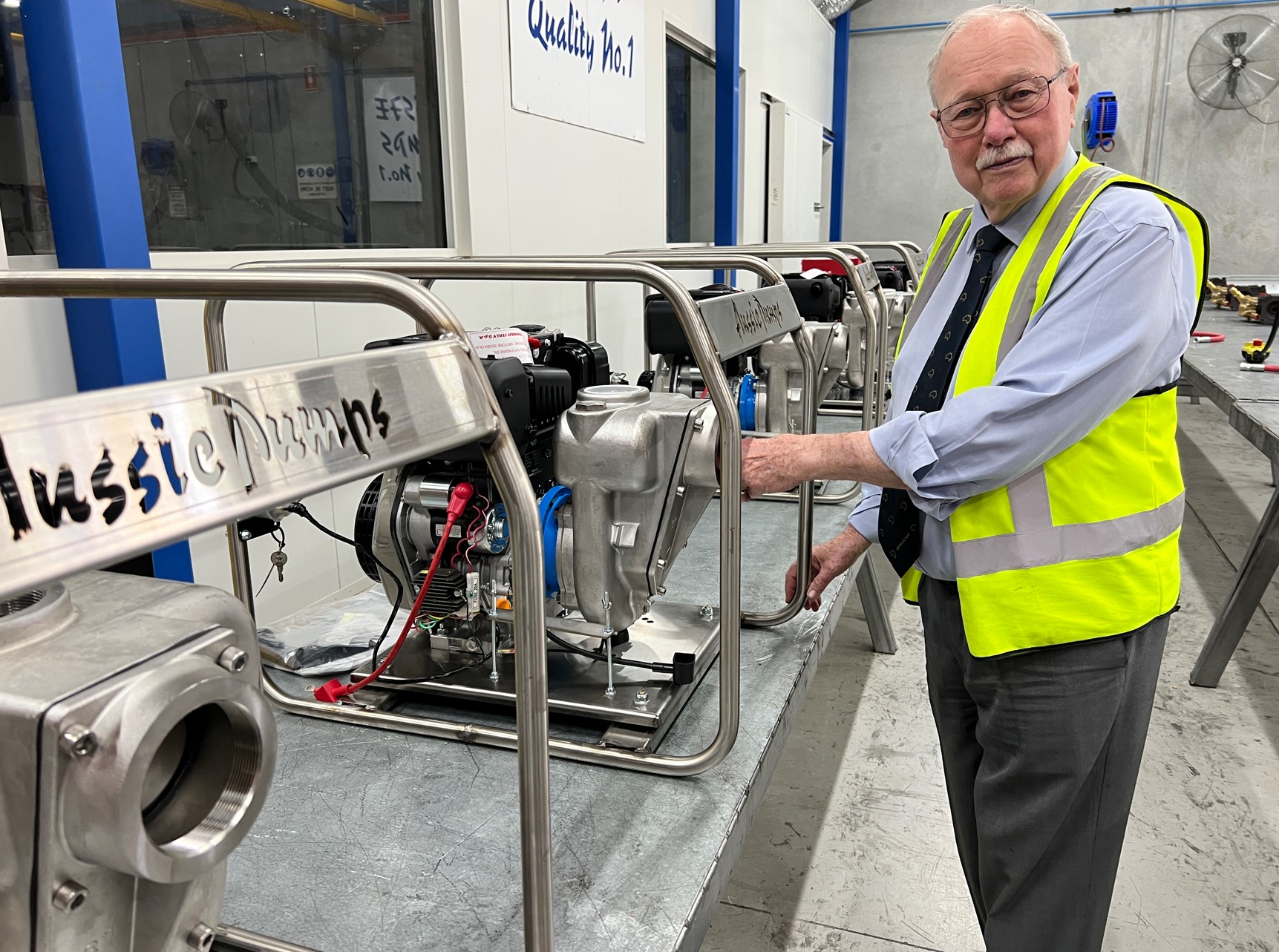
The result has been four years of intensive research, resulting models in 2”, 3” and 4” pumps in 316 stainless steel. They can be operated by hydraulic motor, Yanmar diesel engines or electric motor drive for static applications. The results have been tremendous and the beauty of that is the more we make, the less expensive they become!
The base pumps can be driven by the above range of drive systems, depending on the activity and the requirements of the application. The same body can be used with varied drives. They be sold into piggeries for abrasive liquid handling with a 415V electric motor, driving in a static environment that can also be configured as a stainless-steel pump on a hydraulic motor, a Yanmar diesel engine, even in some cases, a Honda 13 hp petrol engine.
It is astonishing the way even the water cart industry has suddenly switched on to the idea that they can afford a 316 stainless steel pump, all because of our ability to build market presence.
Let’s get down to business
Right now, we put a 2”, 2.2kw, 415V, 316 stainless steel pump on the market, originally at about $6,500. We’re now down to $5,826 as the list price for that product.
The same pump, in 316 stainless steel with a hydraulic motor driving it had a list price of $13,681 and is now down to $8,840 — that’s the whole machine complete with the hydraulic motor attached.
Bigger pumps, like the big three-inch models, what we call our B3XRA series, were originally priced in bare shaft configuration at $10,700 each. The same pump is on the market now for $7,890.
The same pump again in hydraulic drive, B3XRA-X stainless steel pump, was $13,681, now down to $7480. The more we build, the less they cost and the better price we can give the industry.
We’re working on a new super high pressure 3”/3” pump that’ll be in 316. Some of these were put into the market 12 years ago and have never suffered any kind of failure in that time. Our big 4” pump, model B4XRA, is available with a 15kw electric motor or 26hp diesel engine drive. Hydraulic is also an option.
Stability is the key feature of the Australian Pump product profile. It’s in our DNA!
If we smell a problem, we start to understand it, we learn from the market and we aim to give something that is beyond what was possible as a solution.
More Is better
We are pushing this along because we know that as we get more volume, we can provide even better and more competitive prices for these big 316 stainless steel pumps.
“The B4XRA Kohler is ideal for really bad corrosive liquids to be pumped on site. The Kohler engine will match straight up to the B4XRA yet delivers over 2,200lpm and, with a maximum head of about 35m, it will suck through a 6m vertical lift,” Hales said.
Hales is busy now designing a frame in stainless steel with a lift bar to make it easy for miners to use the 4” pump on-site.
That’s not all we do!
Although this preoccupation with stainless steel has cost us a lot of money in development, we don’t just believe in stainless steel. We will continue to supply our heavy-duty cast iron self-priming centrifugal semi-trash pumps to water carters but know that many of them are already hungering to swap over to stainless steel. They know that the pump bodies and impellers will last forever.
Despite that, Aussie is building more of the bigger pumps in their range. The 80hp diesel-powered 6” trash pump has done wonders in flood situations, not just in Australia, but also around the world. Climate calamities are causing real problems, and we’ve been able to ship these big 6” pumps to far as Tonga to Sudan. More inquiries are coming in all the time because of the way we build them.
Aussie re-introduces Toyo dredger pumps.
Hot off the press, Aussie Pumps have made a deal with Toyo, the world’s leading manufacturer of dredger pumps, to represent them in Australia.
The first orders are in the process of formation, and we know that they can start from compact, submersible, four and six-pole to heavy-duty pumps capable of operating in even seawater applications.
Toyo leads the world in dredger pump technology and Aussie Pumps are currently working on major potential projects for this top-quality product.
We’re on your side; we know that reliability and consistent support are the most important factors in the industry.
For more information on Aussie Pumps progressive approach on supporting the mining industry visit aussiepumps.com.au.