Australia’s approach to tailings management is evolving rapidly. Stricter international standards, rising environmental accountability and the growing cost of water are forcing mining operations — from the Pilbara to the Hunter Valley — to rethink how they manage the fine waste left behind after mineral processing.
At the forefront of this shift is a technology that has steadily built credibility across coal, gold, copper, nickel and iron ore sites: the solid bowl decanter centrifuge.
For many years, tailings storage facilities (TSFs) have been the industry norm — large, engineered dams designed to hold slurry waste. Across Australia, billions of cubic metres of tailings are currently stored in these facilities, the majority still active. While remote locations and strong engineering practices have reduced the likelihood of catastrophic failures compared to overseas events, risk remains an industry concern.
The 2019 Brumadinho disaster in Brazil marked a turning point globally, accelerating the introduction of the Global Industry Standard on Tailings Management (GISTM). Major mining houses including BHP, Rio Tinto and South32 are aligning with the framework, and ICMM members must demonstrate compliance across all facilities by August 2025.
One of the core objectives of GISTM is reducing both the volume and hazard profile of stored tailings. For many operators, that begins with removing as much water as possible before tailings ever reach a dam.
This is where Western Australian separation technology specialist Sacor is creating a meaningful advantage through its SADEC two-phase decanter centrifuges and Delta Canter three-phase systems.
How decanter centrifuges operate
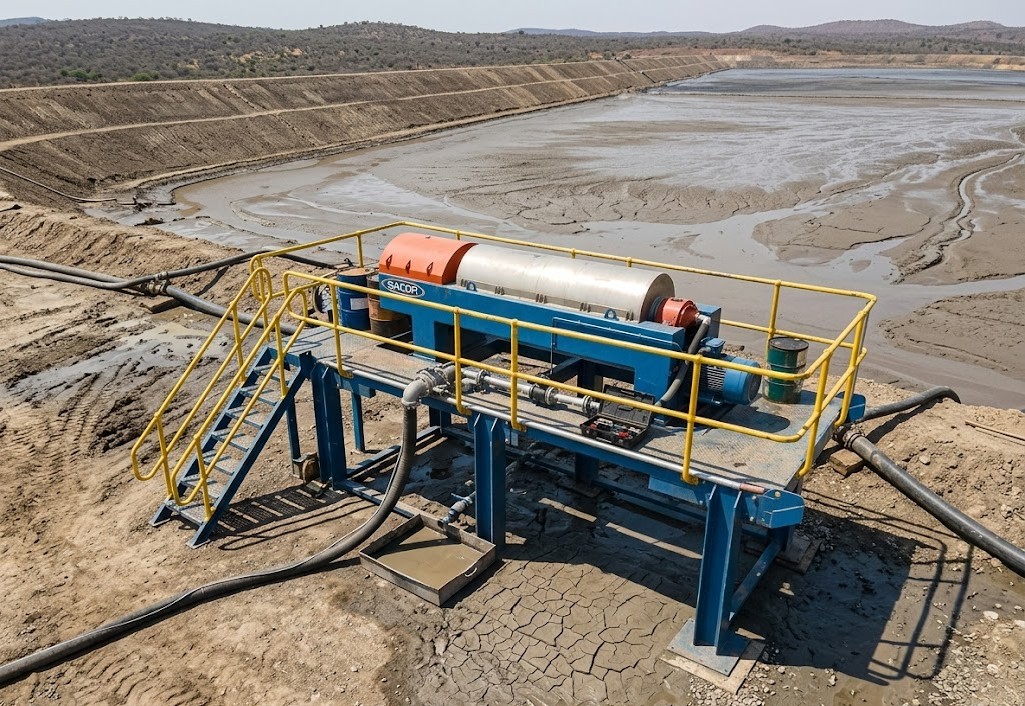
Rather than relying on filtration, decanter centrifuges use high-speed rotational force to separate solids from liquids. Slurry is fed into a rapidly spinning horizontal bowl, generating forces of up to 3,500G. Because solids are denser than water, they migrate outward to the bowl wall. An internal scroll conveyor continuously transports the solids to a discharge outlet, while clarified liquid exits from the opposite end.
The outcome is a dry, stackable cake suitable for dry stacking or co-disposal, along with clean process water that can be reused immediately within the plant.
Sacor’s SADEC range is configured specifically for dewatering, thickening, classification and clarification duties. Where tailings streams contain two immiscible liquids alongside solids — common in base metal circuits, oil-contaminated slurries and some hydrometallurgical processes — the Delta Canter three-phase centrifuge separates all three components simultaneously in a single continuous operation.
Unlike belt presses or pressure filters, centrifuges maintain performance even in high-clay environments, slimes-rich streams and ultrafine particles below 10 microns. There are no filter cloths to blind, minimal wash water requirements and fewer process interruptions due to their continuous operating design.
For Australian operations processing fine gold, copper, tellurium, platinum and challenging coal streams, this operational resilience is a significant benefit.
The water recovery advantage
In a country where water scarcity directly impacts operating costs, recovering process water is more than an environmental benefit — it is an economic one. Sacor’s centrifuge systems can recover up to 85% of water from tailings, allowing it to be returned straight to the plant.
For remote sites where sourcing and transporting water carries substantial expense, closing the water loop delivers measurable savings and reduces dependency on external supply.
Smaller footprint, greater flexibility
Decanter centrifuge installations are also compact. A system capable of processing up to 300m³ per hour typically requires around 50m² — considerably less than comparable filtration systems.
Sacor offers modular, skid-mounted configurations that can be deployed quickly for pilot programs or integrated as permanent infrastructure. This flexibility is particularly valuable for operations approaching TSF capacity or requiring interim dewatering solutions while long-term strategies are developed.
Unlocking value from tailings
Beyond dewatering, centrifuge technology opens opportunities for mineral recovery. Tailings often contain recoverable quantities of valuable metals that were not captured during primary processing.
Sacor’s systems are engineered to isolate and recover residual minerals — including precious and base metals — effectively transforming waste into potential revenue. The Delta Canter system is especially suited to complex separations where multiple valuable phases must be extracted in a single pass.
Engineered for Australian conditions
Operating from south of Perth, Sacor’s engineering team collaborates closely with mining clients to design centrifuge solutions tailored to specific mineralogy, throughput requirements and site constraints. Services span slurry testing, pilot trials, full-scale installation, commissioning and ongoing maintenance, supported by an international portfolio of decanter centrifuge patents.
As regulations tighten, water costs increase and stakeholder expectations grow, centrifuge-based tailings management is becoming a strategic priority rather than an alternative option.
Australian mining is moving beyond reliance on conventional tailings dams — and Sacor’s advanced centrifuge technology is helping lead that transition.
Sacor’s decanter centrifuge systems convert fine tailings into stackable dry solids while recovering up to 85% of process water for reuse — all while unlocking additional mineral value from the waste stream.
Contact Details:
Phone: 1300 74 60 10
Email: solutions@sacor.com.au
Website: www.sacor.com.au