Precise engineering solutions under pressure
Inside the critical repair that restored major Tier 1 operations in the Pilbara
The heavy industrial and mining sectors in WA are some of the most unforgiving environments in the world. As operators push for greater productivity under increasingly demanding conditions, engineering firms capable of delivering accurate, rapid and technically sound maintenance solutions are playing an increasingly vital role across the sector.
For more than two decades Inline Engineering Services has successfully delivered specialised solutions that keep critical infrastructure moving. Founded in 2001 by James Taylor, with a workforce of just four employees, Inline Engineering has since evolved into a multidisciplinary operation employing machinists, boilermakers, riggers, mechanical fitters and fabrication specialists across Perth and Port Hedland.
The company’s ethos is simple: minimise downtime and restore production safely, precisely and efficiently. That commitment has become increasingly valuable in those industries where even a short operational delay can translate into millions of dollars in lost productivity.
Inline Engineering Services extends beyond repairs, the company provides end-to-end support covering engineering assessment, machining, fabrication, installation, alignment and refurbishment for mining and marine clients across WA.
Initially focused on iron ore maintenance, Inline Engineering Services has expanded its expertise into marine services, power generation and large-scale material handling infrastructure. Its capabilities include gearbox and motor changeouts, apron feeder overhauls, laser alignment, fabrication, structural modifications and fine-tolerance mechanical solutions.
Urgent engineering solutions delivered for clients
Inline Engineering Services proved their ability to respond rapidly to high-risk failures under severe operational constraints with a recent project undertaken for one of their major clients.
The team was engaged to deliver an urgent, engineered temporary repair to an apron feeder drive shaft at the centre of the project that had required repair to a high-risk, time-critical mechanical solution, delivering direct profit to client.
At the time of engagement, the apron feeder was restricted to about 17% operating capacity, directly impacting production.
A permanent shaft replacement was scheduled for a future outage, but an interim solution was critical to safely return the asset to service in the meantime.
The engineering challenge was significant. The current driving torque for the output of the gearbox was rated at 530,000Nm and the splined surfaces had degraded so much the external shaft spline and the internal gearbox spline were almost non-existent!
Inline Engineering State Operations Manager, Adam Morgan, says this job was no small feat.
“The client had been told by a national engineering company that an in-situ repair was not possible considering the output torque rating, that’s where they stopped talking and we started investigating,” he said.
“We trended the motor torque data through SCADA and transposed the real-world torque demand through the gearbox reduction. That brought us down to 195,000Nm, then we worked to negate most of the bending load at the repair by introducing adjustable drive stands to reduce the overhung load on the connection point.”
The repair needed to accommodate a design torque requirement of 195,000Nm (with a safety factor of at least two) while also managing potential bending moments that could not be totally removed with the drive stands. The repair would also involve in-situ machining the shaft and installing a stub shaft, moving the drive centreline out and requiring a modified, engineered torque arm adaptor. Complicating matters further, all work had to be performed in situ, partly underground in a tunnel, within an active mining environment with limited shutdown time available.
An impossible job made possible
Confident that Inline’s Pilbara team would be the ones to complete the task, the company engaged with one of its specialist partners MAD3 Engineering to conduct an independent review of Inline’s potential repair methodologies to ensure calculations were spot on. Several options were assessed, including a welded shaft adaptor and a keyed shaft adaptor.
Ultimately, the installation of a shrink disc-mounted adaptor using a machined adaptor paired with a Ringspann RLK603 shrink disc rated to 453,000Nm — more than double the operational torque requirement — was the solution selected for the job. This approach eliminated the need for onsite welding while allowing controlled torque transmission, 120,000Nm of bending torque and precise installation under restricted site conditions.
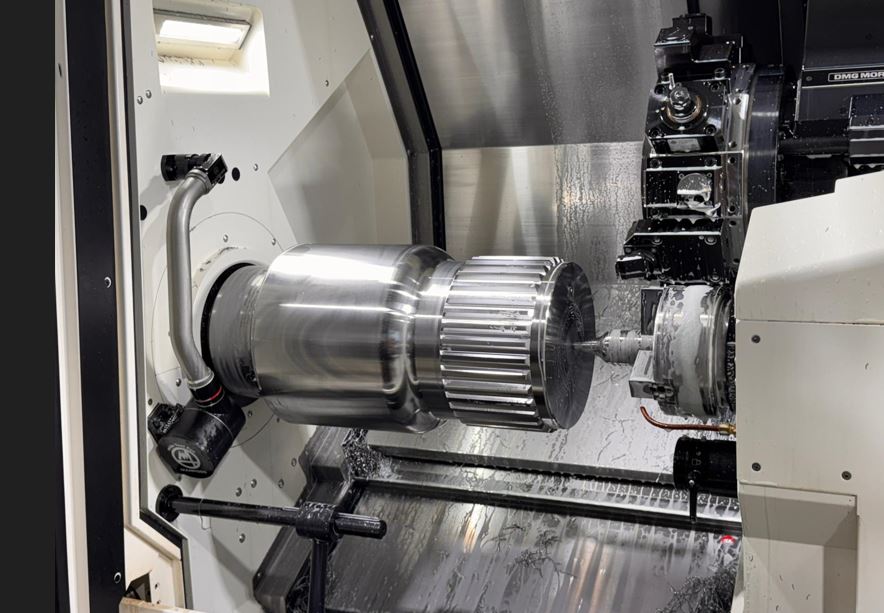
Execution of the repair required a coordinated engineering and mechanical effort. Inline Engineering removed and reinstalled the gearbox and motor assembly, completed in-situ machining of the damaged shaft, fabricated a revised torque arm anchor and installed engineered, adjustable support stands.
Inline Engineering engaged with Ken Saladine of KDS Machining, another of the company’s specialist partners, to assist with in situ machining for the project. All works were completed under approved engineering documentation and site safety systems.
The commissioning phase of the project demonstrated the effectiveness of the solution. Operators progressively ramped the feeder from 17% speed through staged increases up to 84% capacity — exceeding typical operating conditions. Throughout the process, engineers monitored vibration, bearing temperatures and mechanical integrity. No abnormalities were identified during commissioning, and the project was a major success.
Beyond the successful completion of this major project, the outcome was commercially significant. The temporary repair restored the feeder to full operational capability, allowing continued production until the planned permanent replacement could occur during a future outage. At the time of this article, it is still operational in its repaired state and is performing the same as the other three drives on the same line.
For InLine Engineering, the project validated its ability to deliver engineered temporary works for critical mining assets without compromising operational safety or asset integrity.
A changing industry with changing demands
For mining companies operating in remote and high-output environments, projects like this repair illustrate a broader industry trend. Engineering contractors are no longer viewed solely as maintenance providers; they are increasingly strategic partners responsible for protecting operational continuity. The ability to make rapid engineering decisions, execute complex onsite repairs and manage operational risk has become invaluable.
Inline Engineering’s success is a testament to this evolution. The company’s client base, which includes most major industrial organisations across mining, oil and gas and marine industries, underscores the team’s commitment to reliability, precision and timeliness.
As Australia’s mining industry continues to push for greater productivity and reduced downtime, demand for highly specialised engineering maintenance providers will increase. Inline Engineering continues to demonstrate how technical expertise, practical problem-solving and disciplined execution can transform what might otherwise become a costly production crisis into a controlled engineering outcome.
In industries where every operational hour matters, this capability can be the difference between shutdown and continuity.