Beyond the lightning rod
Managing lightning as a whole-of-site mining risk
For mining operations, lightning risk reaches well beyond a direct strike to a structure. Lightning impacts people, production continuity, critical control systems, and decisions made before, during, and after a storm.
By Grant Kirkby, Director – Lightningman Pty Ltd, trading as Lightning & Surge Technologies
Remote mining and mineral-processing operations experience regular seasonal exposure to thunderstorms, often in regions with elevated thunder-day frequency and ground-flash density.
The lightning risk is intensified wherever a large workforce is working primarily outdoors, with limited timely access to safe shelter, along with the remoteness of many sites from primary medical care facilities.
Processing plants, substations, communications networks, explosives and fuel-storage facilities, and rubber-tyred mobile equipment are dispersed across extensive and sometimes changing work areas.
The potential consequences include fatality, injury, explosion hazards, damage to critical control systems and production disruptions.
Start with the risk, not the hardware.
Personnel may be exposed to direct strikes, side-flashes, streamer leaders, touch voltage and hazardous step potentials.
Lightning attachment to heavy mining equipment can initiate tyre pyrolysis resulting in hi-potential tyre explosions. Any HME suspected of sustaining a direct strike requires an exclusion zone extending several hundred meters around the equipment, potentially closing haul roads, primary access roads and potentially interrupting drilling, blasting, loading and processing.
Lightning-induced over-voltages entering critical substations through power, instrumentation, control and communications cabling, can damage MCCs, distribution boards, UPS, PLCs, VSDs, SCADA and critical safety controls.
Effective risk management must protect people, mobile plant and critical infrastructure to support operational continuity.
Risk must influence mine design
Lightning risk is often overlooked during the early layout of HME go-lines, heavy workshops and park up areas, crib rooms, ablutions and critical traffic corridors.
For example, large rubber-tyred equipment parked up in a uniform orientation at a Go-Line may inadvertently direct the hi-potential pressure-wave path from a tyre explosion towards nearby occupied facilities. There have been several such instances on Australian mining operations resulting in worker injury in recent years. Mine design must also provide dedicated tyre fire exclusion areas for HME isolation, exclusion zones and emergency access.
Drill-and-blast personnel are among the most exposed workgroups, yet conventional radios and mobile phones may be prohibited within explosives magazines and sensitive areas. Without remotely operated instantaneous threat notification arrangements, magazine workers may not receive timely critical threat notifications. The interfaces between mine layout, explosives controls, communications restrictions and lightning procedures must be resolved before such operations commence.
Five controls must work together
An effective strategy integrates direct-strike protection; grounding and equipotential bonding, coordinated surge protection, threat detection and notification, procedures and competency. These controls should be supported by a Lightning Management Plan, TARP, defined stop-work and resumption criteria, assigned responsibilities, routine testing and system-failure contingencies.
A credible assessment considers exposed people and activities, structural geometry, equipment movement, power and data services, soil and earthing conditions, detection and warning arrangements, emergency procedures and the consequences of downtime. Findings can then be converted into proportionate controls aligned with AS/NZS 1768, IEC 62305 and IEC 62793, where applicable.
Warning systems must be reliable
Online lightning-location data services can provide useful regional awareness, but their detection efficiency, location accuracy towards intra-cloud and cloud-cloud lightning falls well short of site-based detection systems. This is important considering about 70% of all lightning will be cloud to cloud, but which is still indicative of current high-risk conditions.
Site based systems such as Strike Guard provide a more accurate reckoning of cloud-ground, intra-cloud and cloud-cloud activity, without the latency or reliance upon remote hosted systems.
Strike Guard autonomously escalates whole of site staged warnings through proprietary WAVE siren and strobe stations and can integrate and harmonise threat notifications from a Class A ‘predictive’ sensor for threat warnings several minutes earlier than a first strike.
Protection that moves with production
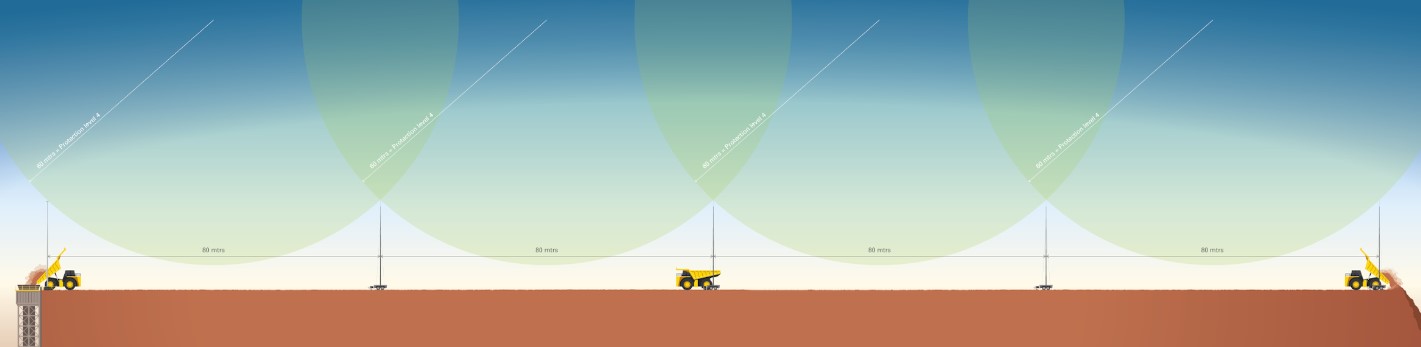
Fixed protection is not always practical in dynamic production areas such as ROM Stockpile – Crusher.
The LightningMast Safe Productivity trailers can be deployed across changing high yield production corridors. When positioned using rolling sphere design methodology, they establish protected operating corridors for safe and continuous production during Red Alert.
Trust our experience
For more than 25 years, Lightningman has focused on the human, operational and technical consequences of lightning.
With more than 150 audits across Australia, Africa, South America and South-East Asia, our experience supports an integrated capability covering hazard and risk assessment, Lightning Management Plans and TARPs, direct-strike and earthing design, surge protection, threat detection and notification, specialist supply and technical review.
“The strongest lightning strategy is not the one with the most equipment. It is the one in which every control has a purpose, every warning produces a known action, and every critical risk has an owner.”
Preparedness is more effective, and more defensible, than reacting after the event.