Connecting the gold plant with ProcessAI
How MetPilot and ProcessAI Operator bring metallurgical reasoning and practical shift support into the development of Liberate ProcessAI Gold
By Krutik Parikh, Director and Metallurgist, Liberate Metallurgy
A recovery change rarely arrives with a clear explanation. The mill may be meeting its target, the leach circuit may look steady, and the latest assay may still raise a question the trend screens cannot settle. Working out what happened means following the material, checking the timing and connecting observations across the plant.
October marks four years of Liberate Metallurgy and the introduction of Liberate ProcessAI™ Gold. Australian made and developed, the platform is being built around two complementary roles: MetPilot™, the AI metallurgist assistant, and ProcessAI Operator™, AI-assisted shift support.
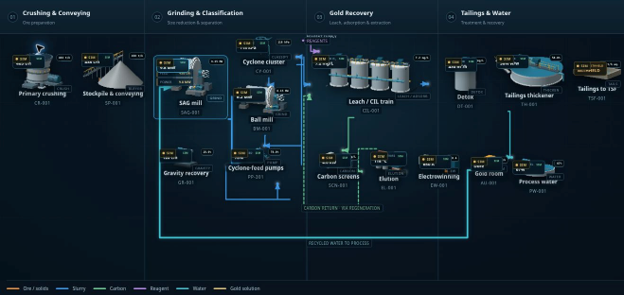
Following the problem through the plant
The starting point is an operating question: where is performance changing, what could explain it, and what evidence would justify a response? In a gold-loss investigation, the answer may involve ore characteristics, grinding, leach conditions, carbon performance or the reliability of the measurements themselves.
ProcessAI Gold is being developed to connect that context across the flowsheet. Its intended scope includes recovery and metal losses, throughput constraints, grinding and classification, leach and adsorption, reagent and energy use, and operating stability.
Our guiding idea is simple: THE WHOLE PLANT. ONE INVESTIGATION.
MetPilot for the metallurgical explanation
MetPilot is being developed to give the metallurgist a useful first interpretation of the available evidence. Its role is to explain the observed change, examine plausible process mechanisms, consider alternative explanations and identify the information needed to distinguish them.
In an illustrative grinding case, a coarser product occurring alongside elevated cyclone-feed density could make classification a working hypothesis. Ore variability or a measurement problem may still explain the observation. A useful assessment would identify independent density checks and representative size samples that could help resolve the question.
The intended benefit is less repeated preparation before the technical discussion can begin. The metallurgist can review the reasoning, challenge the hypothesis and focus the next investigation.
ProcessAI Operator for the shift
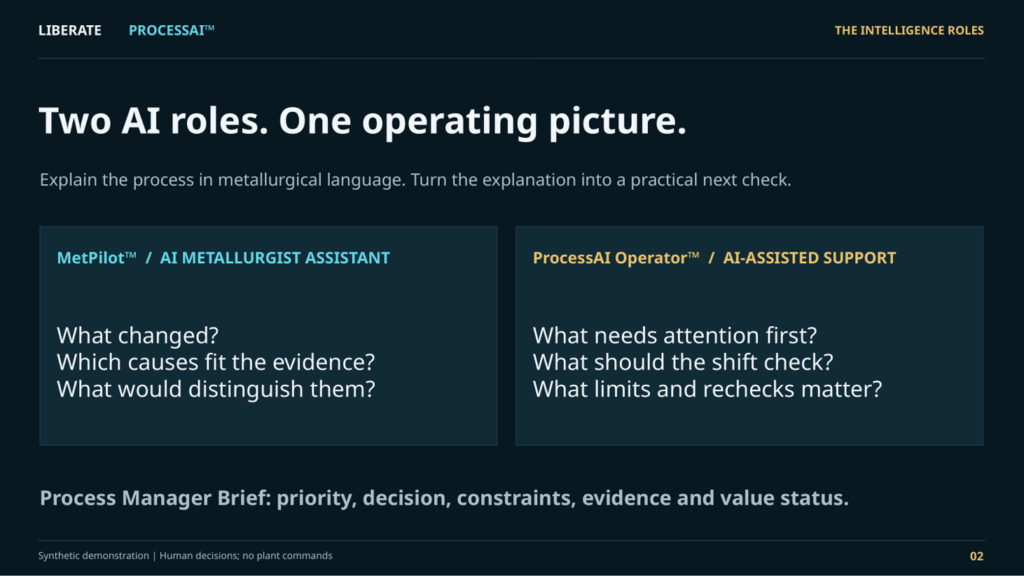
ProcessAI Operator brings the same investigation into the shift’s working language: what needs attention first, what should be checked, which operating limits matter and when the findings should be reviewed.
For the grinding example, that could mean verifying the density measurement, reviewing cyclone availability and underflow condition, and checking overflow size over a comparable operating period. The role is designed to make the next check understandable and keep the reason for it visible.
Operating decisions remain with the site team and its approved procedures. MetPilot supplies the technical explanation; ProcessAI Operator helps turn it into a practical, reviewable sequence.
Technical depth across the flowsheet
The wider Process Intelligence offering includes GrindScope™ for grinding and classification, and CILScope™ for leach and adsorption investigations. These areas bring feed, power, density and product size into the same discussion as oxygen, cyanide, carbon performance and appropriately timed assays.
A connected plant and equipment view provides the operating context. The development workflow uses simulation and replay to examine reference scenarios, while the Process Manager Brief brings priorities, constraints and outstanding evidence into a concise review.
The commercial purpose is to help teams direct their attention towards the plant questions that matter: a developing bottleneck, an unexplained loss, unnecessary consumption or a change whose result needs to be checked.
Putting the approach in front of plant teams
At Liberate Metallurgy, ProcessAI extends our work in optimisation, troubleshooting and process engineering. The aim is to give operators, metallurgists and managers a consistent investigation they can understand and challenge.
ProcessAI Gold remains in development. Current previews use simulated and replay data; site-specific benefits are yet to be validated.
We are inviting selected gold operations into Founding Pilot discussions. A private walkthrough can demonstrate the intended roles of MetPilot and ProcessAI Operator and provide a starting point for assessing one recurring plant problem.