
Northern Star (ASX: NST) has had, quite possibly, one of the most eventful years in its history.
After completing its $6b acquisition of De Grey Mining last year, one of the biggest gold buyouts seen on the ASX, company shares have seen a whopping 60% increase in the last 12 months.
Despite the company’s consistent performance and glittering outlook, investors have been less than impressed by recent guidance revisions off the back of softer performance in Q2 FY26.
With a market still focused on execution credibility, the expansion of the Kalgoorlie Consolidated Gold Mines (KCGM) operations remains the company’s primary target with the recently acquired Hemi project’s moment in the sun now delayed until the 2030s.
Strong balance sheet, revised guidance
Northern Star ended H1 FY26 with $293m in net cash and $2.7b in total liquidity, with underlying profits rising 49% and EBITDA hitting a record $1.876b.
Despite delivering strong results, investors were left disappointed by the lack of explanation following a series of downgrades, including a full-year gold production guidance cut from 1.7–1.85moz to 1.6–1.7moz.
FY26 group all-in sustaining cost (AISC) guidance was increased to $2600–2800/oz from $2300–2700/oz, and production guidance was lowered to 1600-1700koz, from 1700-1850koz.
The company attributed these cuts to several “isolated events”, including the failure of a primary crusher at its Super Pit which was disclosed more than a month later to investors.
There was also an open cut wall slip at the KCGM South Kalgoorlie mine in October last year, attributed to heavy rain, and a crushing-circuit issue at the Jundee site, which the miner has attributed to a potential 20,000oz loss.
At its Thunderbox mine in WA, gold sales were impacted by continued lower than expected ore grades mined from the Orelia open pit and unplanned processing downtime associated with carbon-in-leach tank failures at the site.
Underground mining dilution resulting in lower ore grade at Northern Star’s Pogo operations in Alaska have also affected gold recovery.
In a fiery call with investors and analysts, participants pushed for delivery and commissioning credibility surrounding KCGM and the AISC trajectory, questioning whether management could restore confidence after the softer quarterly performance and guidance resets.
In response to investor queries, Northern Star managing director and chief executive Stuart Tonkin reiterated that KCGM was on schedule to commissioning in early 2027.
“Time is of the essence with KCGM, not capital,” he said.
“We’re in an excellent position going into FY27.”
Despite the performance slowdown, investors have seen generous returns that were lifted by favourable gold prices. However, near-term investor sentiment appears cautious as the company anticipates a stronger performance in the second half of FY26.
The long-term outlook for the company appears more constructive, with the commissioning of KCGM remaining a key milestone. Though the company, and investors, are eager to progress development at the Hemi deposit, the project is unlikely to be a near-term catalyst and instead will be a cornerstone of the company’s future cycle.
“We are confident that our return on capital employed will increase as we bring on projects that are long-life and low-cost,” Mr Tonkin said.
“Our balance sheet is strong and of investment-grade quality.”
KCGM: Northern Star’s crown jewel
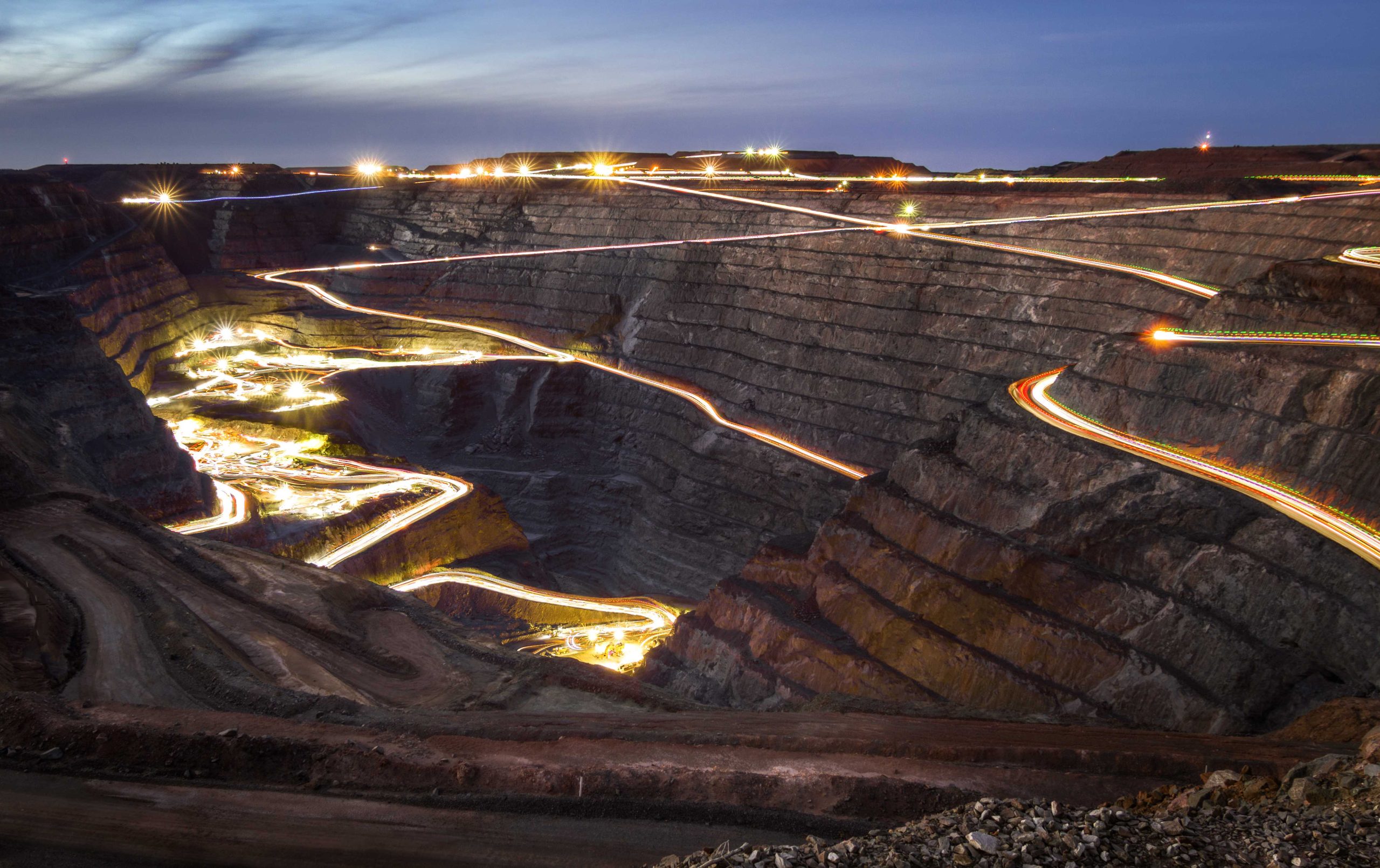
Lying about 600km east of Perth in the historic mining town of Kalgoorlie-Boulder is Northern Star’s flagship project — the Super Pit.
Before the modern Super Pit, the Golden Mile comprised dozens of smaller underground operations. Consolidation efforts accelerated in the 1980s, and the leases were ultimately brought together under KCGM in 1989.
In 1903, there were 49 operating mines and 100 headframes across the region, creating an extensive network that exceeded 3500km of tunnels and shafts.
In the early 1980s, WA businessman Alan Bond began to buy up the individual leases along the Golden Mile with the aim of consolidating them into a single company. Though Mr Bond’s company failed to complete the takeover, a new era for Australian gold mining was ushered in when KCGM was formed.
Operations at what is now called the Super Pit commenced in 1989 when KCGM amalgamated operations via several strategic acquisitions allowing them to combine into one colossal open cut operation.
Now, the pit is about 3.5km long and 1.6km wide, extending to depths of about 600m. producing an average 800,000ozpa, the Super Pit held the title of Australia’s largest open cut gold mine until 2015, when it was overtaken by Newmont’s (ASX: NMT) Boddington gold mine.
Barrick Gold and Newmont owned the KCGM operations in an equal joint venture until Barrick began its retreat from and unsuccessfully attempted to sell its stake in 2016.
Following a major pit wall slip in 2018 that resulted in about 1mt of ore falling into the pit, guidance was cut by 25%. Barrick successfully sold its stake to Saracen Mineral Holdings in late 2019 for $750m, with Newmont following closely behind with its sale to Northern Star in early 2020.
Following Northern Star’s takeover of Saracen in early 2021, the KCGM operations became controlled by a single entity, Northern Star, for the first time in its history.
Since taking the reins at KCGM, Northern Star has undergone aggressive exploration and development projects to shift the projects perception as a historic asset to one that is a premier, low-cost and long-life operation.
These projects have resulted in a 66% increase in resource base to 32moz of gold and a reserve increase to 13moz, which Northern Star predicts will extend the mines life by more than 20 years.
Expanding KCGM
At the helm of this revolution is Northern Star’s $1.5b KCGM mill expansion project.
Now about 86% complete, the expansion is one of Northern Star’s most significant processing infrastructure developments ever. The project was given the greenlight from the company’s board in 2023 and is on track to commissioning in early FY27.
Full production capacity of 27mtpa, more than double the sites current 13mtpa baseline, is targeted by FY29. Underground growth, namely at KCGM’s Mt Charlotte site, is projected to rise to 6mtpa by FY29 to feed the newly expanded mill.
Northern Star anticipates the expansion to position KCGM as one of the world’s most technologically advanced gold processing facilities. Incorporating advanced processing technologies, including automated ore sorting systems, sophisticated process control systems and data-driven operations, the expansion is designed to optimise material handling efficiency and maximise gold recovery rates.
During the half year investor conference call, Mr Tonkin reiterated that KCGM’s growth positions the business for a significant uplift in cash generation and ROCE from FY27.
“This enhanced cash flow outlook strengthens our ability to deliver attractive returns on investment and supports capital management,” he said.
During the call, Mr Tonkin also confirmed that total KCGM capital investment had increased to $1.65-1.69b, reflecting lower-than-planned productivity and schedule protection measures.
Northern Star also lifted its KCGM mill expansion capex from $530–550m to $640–660m.
Northern Star chief financial officer Ryan Gurner says completing the KCGM expansion remains the company’s focus.
“This milestone will mark the beginning of a step change in returns and cash flow at this asset,” he said.
Hemi: Northern Star’s second act
The Hemi deposit is one of the largest undeveloped gold projects in a Tier-1 mining jurisdiction globally, boasting a mineral resource of 11.2moz, ore reserves of 6moz and a forecast annual gold production of 530kozpa over its first decade of production.
The high value of the project is attributed to its size, grade continuity and its potential to be mined by large scale and low-cost open pit mining.
De Grey Mining, the Hemi deposits founder, originally told its investors that gold production at the site could commence as early as 2027 following a $1.3b build out. After Northern Star acquired the site, via a $6b takeover, a concrete timeline was not given.
In February however, Northern Star confirmed the schedule had slowed — likely delayed to the 2030s — largely due to uncertain government approvals timelines.
Northern Star chief executive Stuart Tonkin says, given the uncertainty and issues outside of the company’s control, a final investment decision is now expected sometime during FY27.
“With an estimated 2.5-year build, this corresponds to first gold being forecast for FY30 at the earliest,” he said.
Northern Star is taking a disciplined and realistic approach to maintain its balance sheet with intentions to use cashflows potentially boosted by the completion of the KCGM mill expansion to fund the construction of Hemi.
“This timing also allows our internal project team to smoothly transition following the completion of the KCGM expansion to focus on Hemi. Further, it provides time for our balance sheet to strengthen from the uplift of free cash flow at KCGM,” Mr Tonkin said.
“I think we want to walk before we run here, really get it commissioned, get it vetted in and delivered in growth.”
Northern Star’s ability to deliver on its revised guidance, stabilise operations and successfully advance its KCGM expansion will determine whether the company fulfils its promises of a strong finish for FY26 as shareholders await evidence of execution credibility.


