Heat Trap Solutions is helping mine sites move from seasonal fixes to year-round compliance by design
Every summer stress-tests Australia’s mine-site safety systems. For many operators, what it reveals is uncomfortable. Heat Trap Solutions is working with sites across the country to make sure they never face the same problem twice.
For safety managers in mining, the weeks after a Pilbara summer are indicative across the industry and follow a familiar pattern. Maintenance logs are reviewed, audit findings are compiled, and the same questions surface: why did that emergency safety shower fail the temperature check? Why are anti-scald valves wasting water again? Why is Legionella appearing in a system that was flushed just last month?
These are not random failures. They are the predictable result of safety shower systems designed for compliance on paper but not engineered for the realities of Australian mining. Ashley Challenor, managing director of Heat Trap Solutions, has seen this cycle across mining operations from the Pilbara to Queensland for more than a decade.
“Summer doesn’t cause these problems. It exposes them,” Challenor says. “The root cause is a system design that treats safety shower compliance as a checkbox rather than an engineering outcome.”
Compliance is the floor, not the ceiling
Australian Standard AS4775 is clear: emergency safety showers must deliver tepid water, between 15oC and 37.8oC, within one second of activation. What the standard does not specify is how to achieve that in an environment where incoming mains water can reach 47oC and above, where pipework sits exposed in direct sun, and when the nearest maintenance team may be hours away.
The traditional approach of anti-scald valves, periodic flushing schedules, and temperature testing is reactive by nature. It manages symptoms without addressing the underlying design problem: dead legs that stagnate, pipework that heats, and systems that are only as reliable as the last maintenance visit.
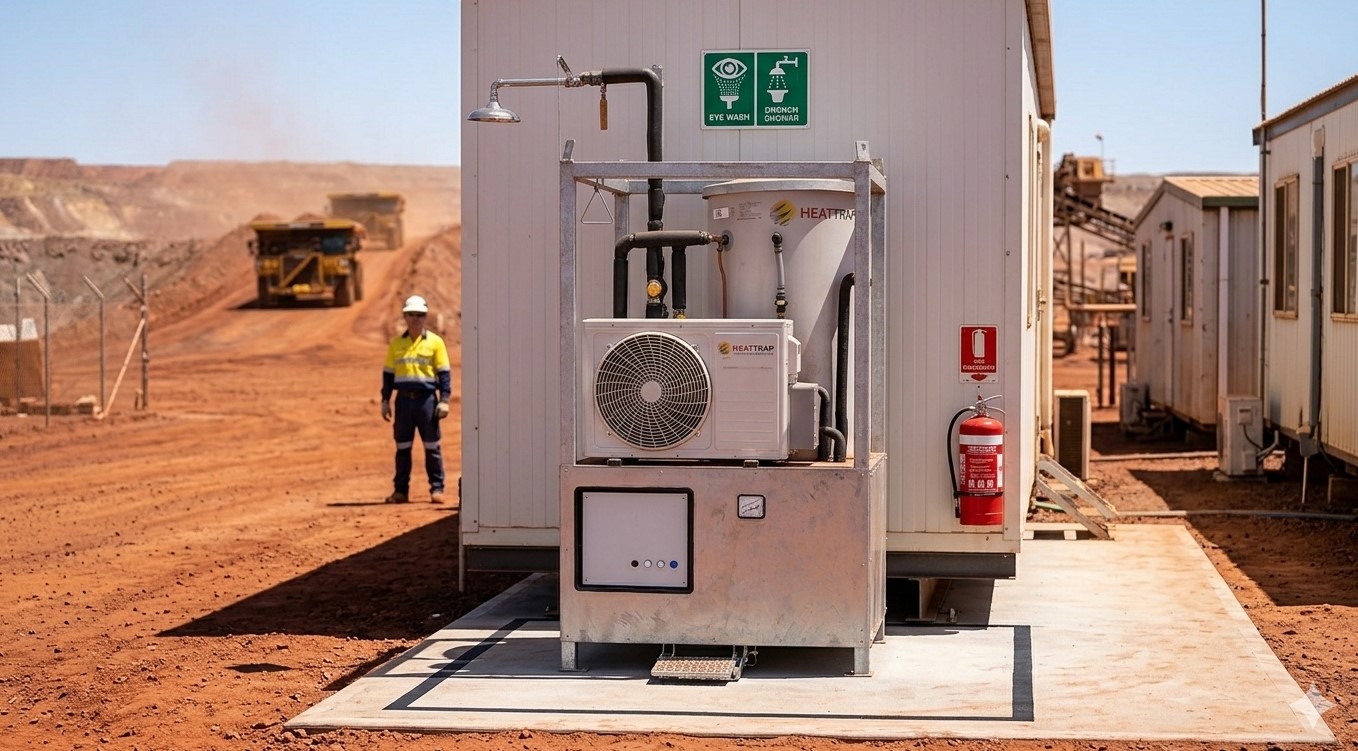
Heat Trap’s circulated safety shower cooling system takes a different approach. By continuously circulating tepid, UV-sterilised water through a closed-loop system with no dead legs, the risk is engineered out rather than managed around. Water is maintained at safe temperatures and sterility between activations, not just after a flush.
This shift in thinking, from reactive compliance to proactive design, is at the centre of what Challenor describes as the maturity curve across the industry. The sites that do it well have stopped thinking about safety showers as a maintenance issue and started thinking about them as an infrastructure standard. That is when the repeating failures stop.
Proven in the field
Heat Trap’s approach has been deployed across mining, oil and gas, and heavy industrial operations throughout Australia. At Paulsens Gold Mine, SC333C chiller units have been installed with integral safety shower stations on the elevated processing deck, an environment where ambient conditions are extreme and reliable emergency response is non-negotiable.
The results are consistent: elimination of anti-scald valve water loss, removal of Legionella risk from the water supply, and compliant tepid water available within one second of activation, regardless of ambient temperature or time since last use.
If your post-summer audit revealed temperature failures, Legionella results, or anti-scald valve losses, the problem is not about maintenance discipline. It is about inadequate design. Heat Trap Solutions engineers the risk out permanently by design, rather than asking you to manage it seasonally.
Contact Heat Trap Solutions today to assess your current system and move from seasonal compliance to year-round reliability.
Heat Trap Solutions Pty Ltd Unit 5, 37 Howe Street, Osborne Park WA 6017 1300 722 715 sales@heat-trap.com.au www.heat-trap.com.au
Howe Street, Osborne Park WA 6017