Budget Breakdown
The mining industry managed to dodge any new taxes in the 2026–27 Budget, but a battle has ensued over net zero, approvals, commodity revenue and the future of coal.
The Federal Government outlined a plan to put money behind faster approvals, critical minerals stockpiling, fuel security and domestic industrial capability, led by a $227.4m approvals package, aimed at cutting duplication and speeding up environmental and investment decisions.
It has also committed $14.8b to fuel security as conflict in the Middle East drives oil prices higher amid global shortages, including $10b for immediate fuel supplies and the establishment of a permanent fuel reserve.
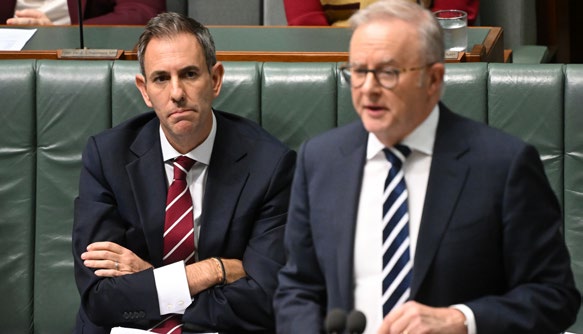
But the Opposition has hit back, vowing to scrap net zero, the Safeguard Mechanism and rework Australia’s project approvals system under a future Coalition Government. In his first Budget reply as Opposition Leader, Angus Taylor said a future Coalition Government would remove carbon costs on mining, manufacturing and electricity, vehicles
and imports, arguing Labor’s climate agenda was driving up energy and industry costs.
Mr Taylor also voiced his support for both coal-fired power and nuclear energy, saying a Coalition Government would work with coalfired power stations to keep them “running as long and as hard as possible,” arguing the shift away from coal and gas had contributed to higher electricity prices.
Mining industry gets no new taxes, faster approvals
The Federal Government has left mining taxes unchanged in the 2026–27 Budget, instead putting money behind faster approvals, critical minerals stockpiling, fuel security and domestic industrial capability.
The key industry-facing measure is a $227.4m approvals package aimed at cutting duplication and speeding up environmental and investment decision making.
This includes $105.9m across four years to modernise environmental information, data and digital systems, including through artificial intelligence.
The Minerals Council of Australia has welcomed this measure, saying that approval delays are a handbrake on the economy, with multiple mining projects, more than 5000km of transmission lines and 26,000 homes caught up in an approvals backlog
To avoid duplication during approvals, the Federal Government will allocate $47.6m to progress bilateral and approval agreements with states and territories, enabling them to conduct assessments and approvals on the Federal Government’s behalf.
“Delays kill projects. Speeding up and simplifying approvals is the most important plank of the Federal Government’s productivity agenda,” WA Chamber of Minerals and Energy chief executive Aaron Morey said.
“We’re at a make-or-break stage with the National Environmental Standards that underpin the EPBC reforms currently being negotiated. If we don’t get those right, the opportunity for a bilateral agreement disintegrates.
“CME continues to push for workable standards and a bilateral between WA and the Commonwealth by the end of the year.”
AMEC chief executive Warren Pearce says streamlining approvals and reducing duplication is critical if Australia wants to remain globally competitive for investment in mining and critical minerals projects.
“The commitment towards greater use of technology, including AI-assisted assessment processes, has the potential to significantly improve timelines and reduce unnecessary administrative burden,” he said.
A further $47.5m will be used to strengthen and streamline Australia’s foreign investment approval framework, including a new target to decide all low-risk applications within 30 days from January 1, 2027.
Critical minerals also received targeted support via a $173.3m package across five years to support the sector. This includes $150m for selective stockpiling of critical minerals, $20.4m to support the operation of the critical minerals strategic reserve and $2.9m to help deliver international critical minerals agreements.
The reserve will draw on $1b from the existing $5b critical minerals facility for transactions and will initially focus on antimony, gallium and rare earth elements.
Heavy industry was another major focus, with up to $1b committed to secure the long-term future of the Boyne Island aluminium smelter. The support, to be matched by the Queensland Government, is expected to usher in $7.5b in private investment and support Boyne’s transition to aluminium production using renewable energy.
The Government is also providing $222.6m to support and stabilise the Whyalla Steelworks during administration, alongside time-limited support for workers at the Liberty Bell Bay manganese smelter while it remains in administration.
While industry has broadly welcomed the Budget measures, exploration expenditure remains a point of contention.
The sector has called for measures such as the Junior Minerals Exploration Incentive (JMEI) to be reinstated in the Federal Budget after it was removed last year.
AMEC says it continues to advocate for stronger long-term support measures for junior explorers, including renewed commitments towards exploration incentives that encourage private investment into high-risk greenfields exploration.
“Australia cannot afford to become complacent on this front,” Mr Pearce said.
“You cannot have new mines, new jobs, new royalties and new export revenue if discoveries are not being made in the first place.”
Federal Government locks in permanent fuel reserve, warns oil could hit $200/bbl
The Federal Government has committed $14.8b to fuel security as conflict in the Middle East drives oil prices higher amid global shortages.
The Federal Budget includes a $10b investment in immediate fuel supplies and the establishment of a permanent fuel reserve.
Treasury’s central forecast assumes oil remains around $100/bbl until the end of next month before easing to $80 by the end of June next year. If war in the Middle East continues, Treasury warned oil could peak at $200/bbl, with inflation rising above 7% in a more severe scenario.
Treasurer Jim Chalmers said war in the Middle East was pushing up prices, pushing down growth and punishing Australia.
“We’re dealing with a fifth economic shock in less than 20 years,” he said.
“The conflict in the Middle East and closure of the Strait of Hormuz has disrupted the global economy and the global outlook.
“Oil production fell by 8 million barrels a day in the first month of the war – almost eight times more than any of the oil shocks since the 1970s.
“The global oil price started the year around $60 and has now been above $100 for the bulk of the past two months.
“A third of the world’s seaborne fertiliser has been stuck, putting pressure on food production, food security and supermarket prices.
“All of this has made the outlook much more uncertain.”
The Budget expands the Minimum Stockholding Obligation, requiring an additional 10 days’ supply of diesel, jet fuel and petrol to be held in Australia.
It also establishes the $3.2b government-controlled Australian Fuel Security Reserve, which will hold about 1b litres of diesel and jet fuel, serving as an additional buffer during future supply crises.
Together, the Federal Government says the measures will increase Australia’s diesel and jet fuel reserves to 50 days.
The package also seeks to reduce Australia’s exposure to supply shortages by supporting the country’s two oil refineries and committing $10m to feasibility studies into expanding domestic refining capacity.
The Federal Budget also includes a 20% domestic gas reservation scheme, requiring LNG exporters to set aside a portion of production for the domestic market from July 1, 2027.
Separate cost-of-living measures include a $2.9b package to more than halve the fuel excise and reduce the heavy vehicle road user charge to zero for three months from April 1, 2026.
Opposition vows to scrap net zero in Budget reply
Net zero, the Safeguard Mechanism and Australia’s project approvals system would be put on the chopping block under a Coalition Government.
In his first Budget reply as Opposition Leader, Angus Taylor said a future Coalition Government would remove carbon costs “on mining, manufacturing and electricity, vehicles and imports”, arguing Labor’s climate agenda was driving up energy and industry costs.
“Prioritising net zero and emissions reduction above all else has seen cheap, always-on power dismissed for expensive, sometimes-on industrial-scale renewables,” Mr Taylor said.
“Net zero must go.”
Mr Taylor also said the Coalition would abolish the Safeguard Mechanism, arguing it was pushing up prices on essential building materials and undermining industry investment and pushing capital offshore.
The Coalition Government would also rewrite and simplify Australia’s legislative rule book, including the EPBC Act, in a push to accelerate project approvals.
Mr Taylor said a Coalition Government would work with coal-fired power stations to keep them “running as long and as hard as possible,” arguing the shift away from coal and gas had contributed to higher electricity prices.
“Pushing out gas and coal generation has caused power prices to surge by 40%,” he said.
Mr Taylor took the opportunity to reiterate the Coalition’s support for nuclear energy, vowing to lift Australia’s nuclear ban while also criticising government spending on green hydrogen, describing some projects as “pie in the sky schemes”.
A central resources measure was outlined through the Coalition’s Future Generations Fund, which would be used to pay down debt and invest in infrastructure.
This would direct 80c of every dollar from future commodity-driven revenue upgrades into the fund, with 25% of spending reserved for resource-rich regional areas.
Mr Taylor said Labor had received about half a trillion dollars in commodity revenue upgrades, largely driven by higher resource prices, but had “squandered resource profits with self-indulgent spending”.
Beyond resources, negative gearing and capital gains measures were key concerns for the Opposition, alongside small business tax and migration policies.
Mr Taylor said that a Coalition Government would reserve the NDIS and 17 different welfare programs for Australian citizens only.