Digitising Slurry Pump Maintenence
How loT is reshaping mining operations
What if a slurry pump could tell you when maintenance is required, automatically adjust to changing conditions and help prevent costly downtime before it happens?
In today’s mining landscape, operations are under increasing pressure to move more material, more efficiently — often with reduced manpower and slimmer margins. As slurry pumps grow to support higher throughputs, maintenance becomes more complex. For many sites, improving pump maintenance is now a critical way to lift productivity, reduce unplanned outages and lower total operating costs.
Traditional maintenance methods are struggling to keep pace. Time-based schedules can replace components before their useful life is reached, while reactive maintenance can lead to costly interruptions after performance has already declined. Digitisation is changing this approach by helping operators move toward condition-based maintenance, supported by real operating data.
At KSB GIW, digital slurry pump development is shaped by the practical challenges customers face every day. Technologies such as GIW®RAMSL, GIW®SLYsight IoTand Automation Lab are helping mines improve maintenance precision, increase visibility into pump condition and build the foundation for more intelligent, connected pumping systems.
A changing maintenance landscape
Slurry pumps are among the most critical and heavily loaded assets in a mining operation. Many run continuously while handling abrasive or corrosive slurries that accelerate wear. Historically, assessing internal wear or adjusting wet end components required shutdowns, manual inspections or intervention only after performance had dropped.
Maintenance teams also need to align pump service cycles with broader plant shutdown schedules. This creates a difficult balance: replace parts too early and lose usable life or wait too long and risk unplanned downtime.The question is no longer whether digital tools will be adopted, but how effectively they can be integrated into everyday maintenance.
GIW®RAMSL: improving adjustment precision
One important maintenance activity is maintaining the correct nose clearance between the impeller and suction liner. A tight nose gap reduces internal recirculation and supports hydraulic performance. As the suction liner wears and the gap increases,efficiency declines and component wear can accelerate.
Even small efficiency losses can become significant. A 2–3% drop may appear modest, but in continuous-duty applications it increases energy use and operating cost.In one representative example, a single pump operating at approximately 5000m3 per hour, 45m of head and a slurry specific gravity of 1.5 can incur around $40,000 per year in additional energy costs from a 3% efficiency loss. Across multiple pumps, these incremental losses quickly add up.
GIW®RAMSL, short for remotely adjusted mechanical suction liner, was designed to make nose gap adjustment faster and more precise. The system allows operators to remotely adjust nose clearance down to approximately a quarter of a millimetre,reducing time and manpower while improving consistency and repeatability.
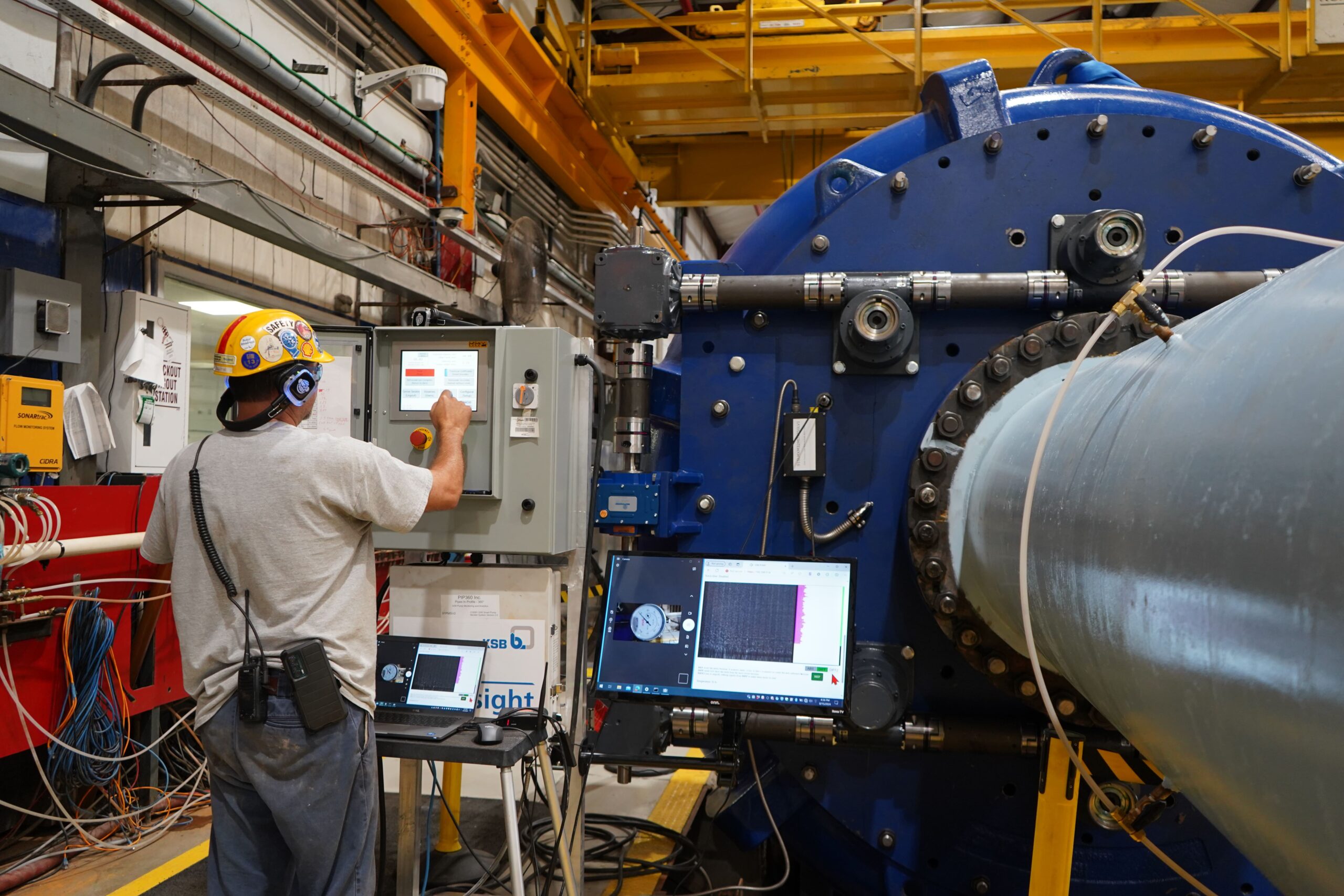
Designed for large slurry pumps, GIW®RAMSL can handle demanding loads. OnKSB GIW’s MDX-750 pump, it can applyabout 200t of force to reposition internalparts across the pump’s full pressure range. Operators can make adjustments from a control panel while accessing operational data and maintenance records, supporting a broader move toward IoT-ready equipment.
GIW®SLYsight: improving visibility into wear
While GIW®RAMSL improves adjustment capability, GIW®SLYsight helps maintenance teams understand when action is needed.Traditionally, visibility into wet end wear has been limited to specific moments: when the pump is new, during a planned shutdown or after a failure. Between those points, decisions often rely on schedules or estimates rather than known component condition.
GIW®SLYsight closes this gap by using sensors embedded in key wear areas to monitor component thickness, wear patterns and internal clearances while the pump is running. Wear data is displayed through a dashboard, showing changes over time and providing estimated remaining wear life in hours to support maintenance planning.
For nose gap adjustment, GIW®SLYsight measures the clearance between the suction liner and impeller, so teams know exactly when adjustment is required. During adjustment, sensors provide audio and visual alerts as the suction liner approaches the impeller, giving technicians greater confidence and control.
The benefits extend beyond adjustment accuracy. In field use, operators have been able to observe how components wear over time and extend maintenance cycles to match actual wear life. Sites using GIW®SLYsight have reported up to 50% longer wear life by maintaining proper nose gap clearance, as well as efficiency gains of 5–10% when maintenance intervals are extended appropriately. The system can also provide early warning of abnormal wear, helping sites avoid unplanned outages.
From insight to measurable result
Together, GIW®RAMSL and GIW®SLYsight respond to many pressures facing modern mining operations. They help maintenance teams visualise internal pump conditions, make more informed decisions and reduce unexpected issues between inspections. By supporting tighter clearances and better maintenance timing, these technologies can also contribute to lower energy use, reduced operating costs and more sustainable performance over the life of the asset.
Building toward intelligent pump systems
To support demand for IoT-enabled pumping solutions, KSB GIW has established an IoT and Automation Lab dedicated to the design, testing and application of digital technologies for mining. The lab is focused on delivering insight faster, expanding system visibility and simplifying integration with next-generation slurry pump designs and plant control systems.
Looking ahead, KSB GIW’s vision is to create intelligent pump systems that can largely manage themselves. This evolution moves beyond monitoring toward an integrated digital ecosystem where systems not only report data but communicate and act on it.
The long-term goal is a pump that can automatically adjust based on real-time wear and performance data with minimal human intervention. By embedding machine learning and forward-looking analytics, KSB GIW is laying the groundwork for systems that can predict issues, optimise performance and support data-driven maintenance. For mining operators, this represents a shift away from strictly scheduled or reactive maintenance and toward continuous insight, smarter service planning and more connected slurry pump operations
KSB Australia
P: 1300 073 887