Unlocking More Performance from Filtration

For mining and mineral processing operations seeking greater productivity, filtration performance can offer opportunities well beyond the cost and life of filter media. Drawing on the established expertise of Micronics and SOLAFT, now part of Cleanova, this article examines how media, equipment and operating conditions interact to influence performance from existing plant.
Pressure to improve productivity is a constant across mineral processing. When a process becomes constrained, attention naturally turns to major equipment: is more capacity required, does existing plant need upgrading, or is further capital investment necessary?
Filtration deserves a place in that discussion. Its performance can affect throughput, product or residue characteristics, as well as maintenance requirements and the availability of equipment elsewhere in the process. Within the filtration system itself, the chosen media can have a disproportionate influence on the results achieved.
Filter cloth is a consumable, but its performance should not be assessed solely by purchase price or replacement interval. Cycle time, cake moisture and release, filtrate quality, maintenance intervention and process consistency all contribute to the operational picture. Premature cloth failure also brings additional changeouts and downtime.
This means the most economical media is not necessarily the cloth that lasts longest or costs least. The more useful question is how effectively it contributes to the performance of the filtration process – and therefore wider operations – as a whole.
Engineering media around the application
Drawing on decades of experience through established filtration businesses including Micronics and SOLAFT, Cleanova approaches media selection as part of a wider application engineering process.
Slurry characteristics, particle size distribution, abrasiveness, chemical conditions and filtration pressure can all influence media performance, as can the mechanical condition of the equipment and the way it is operated. Media construction and material selection must balance requirements including permeability, particle retention, cake release, mechanical stability and resistance to wear.
Correctly specified filter media can help an existing filtration asset process more material in the time available. In batch filtration, media that supports faster, more consistent filtration and effective cake release can shorten cycle times, allowing an installed press to complete more cycles per shift. Where filtration is a production constraint, those additional cycles can increase throughput without adding another press.
Media selection can also influence how much productive time the equipment loses to maintenance. Filter cloth that is properly matched to the slurry, equipment and operating conditions can reduce premature wear, leakage and unnecessary cloth changes. Fewer interventions mean greater equipment availability and less maintenance labour and downtime. The value of selecting the right media therefore lies in its contribution to higher throughput, greater asset availability and lower operating cost, as well as the life and cost of the cloth itself.
Examples from iron ore tailings and alumina processing show how a broader view of filtration can deliver measurable improvements.
Improving performance in abrasive conditions
At a large iron ore tailings operation, highly abrasive material was contributing to premature cloth wear, leakage, inconsistent cake formation and variable filtration cycles. Existing filter media was achieving approximately 1,400–1,500 cycles.
Rather than make a like-for-like cloth substitution, the filtration team assessed the process more broadly. This included slurry characteristics and wear patterns alongside wash cycles, membrane squeeze, drying, core blow, plate shaking and filter press operating practices.
The review showed that performance depended on addressing both the highly abrasive tailings and the cloth’s interaction with the filtration system. This identified the need for application-specific media and optimisation of the wider filtration set-up.
PrimaPress filter media with a specialised polymer and multi-layer fabric construction selected for the abrasive application was installed. Cloth and plate feed design was also optimised and wear points monitored as part of the application engineering approach.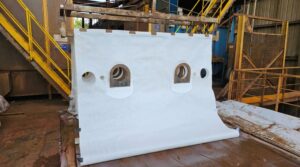
Average cloth life subsequently increased to more than 1,900 cycles – approximately 36 per cent longer than the previous media – but improvement was not confined to cloth life. Average cake moisture fell by up to two percentage points and filtration cycle times were reduced by around 20 per cent, or approximately nine minutes per cycle. Cake formation and release also improved, while leakage and abrasion were reduced.
Removing a filtration bottleneck
In a second example, a refinery was using filtration to dewater bauxite residue for dry stacking. Premature cloth failures were contributing to frequent repairs, maintenance interventions and unplanned downtime. Average cloth life was around 900–1,200 cycles, while some head cloths were failing after as few as 300 cycles.
Working with the operation’s engineering and production teams, filtration specialists used laboratory evaluation, comparative trials and application engineering to investigate the failures and develop media suited to the operating conditions.
Following trials, average cloth life increased to more than 4,000 cycles, with the best performance reaching 5,500 cycles. Spot replacements were substantially reduced, helping to cut maintenance intervention and production interruptions. For an operation where residue dewatering is integral to maintaining continuous production, the value of improved filtration reliability extended considerably beyond the expenditure saved on replacement cloth.
Treating performance changes as diagnostic information
Changes in cloth life, cycle time, cake moisture, cake release or filtrate quality can provide useful clues to what is happening within a mineral processing operation. When performance deteriorates, operators should consider:
- Has the feed changed? Changes in slurry characteristics can alter the demands placed on the media.
- Where is wear occurring? Localised abrasion can provide clues to premature failure.
- Have operating practices changed? Changes to the filtration cycle can affect media performance.
- Is the cleaning regime appropriate? Inadequate or unsuitable cleaning can affect cloth performance and consistency.
- Is the equipment contributing to the problem? Mechanical condition can influence media wear and filtration performance.
- Is the media still suited to the application? Filter construction and material should match current slurry and process conditions.
Answering these questions can help distinguish a media problem from a wider process or equipment issue. It is why effective filtration optimisation requires application engineering alongside media expertise. The principle applies across pressure and vacuum filtration, including filter presses, disc filters and horizontal belt filters.
Turning filtration insight into performance
For operators looking to improve throughput, reliability or the utilisation of existing filtration assets, the starting point is understanding current performance and what is constraining it. Media optimisation may be only part of the solution, but it merits investigation before productive capacity is assumed to be unavailable.
Identifying the cause of deterioration – or opportunities for further improvement – may require specialist filtration expertise. An effective filtration partner should be able to assess the application as a system, determine where performance is being constrained and recommend changes based on the operational outcome the processor is trying to achieve.
Established Australian expertise, broader global capabilities
Micronics and SOLAFT are established names in filtration for mining and mineral processing. Following Cleanova’s acquisition of the Micronics Engineered Filtration Group in 2025, their expertise has become part of a broader filtration group with complementary capabilities in engineered filter media, process filtration, pressure and vacuum filtration, application engineering and technical support.
For Australian operators, the practical benefit is access to familiar filtration expertise supported by additional technologies and resources across the wider Cleanova group.
Cleanova Micronics Australia, based in New South Wales, provides a local point of contact for mining and mineral processing operations seeking to improve throughput, reliability and the utilisation of existing filtration assets.
Meet the Cleanova Micronics Australia team at Mill Operators Conference 2026, Stand 128, to discuss media selection, filtration bottlenecks and opportunities to improve performance from existing equipment.