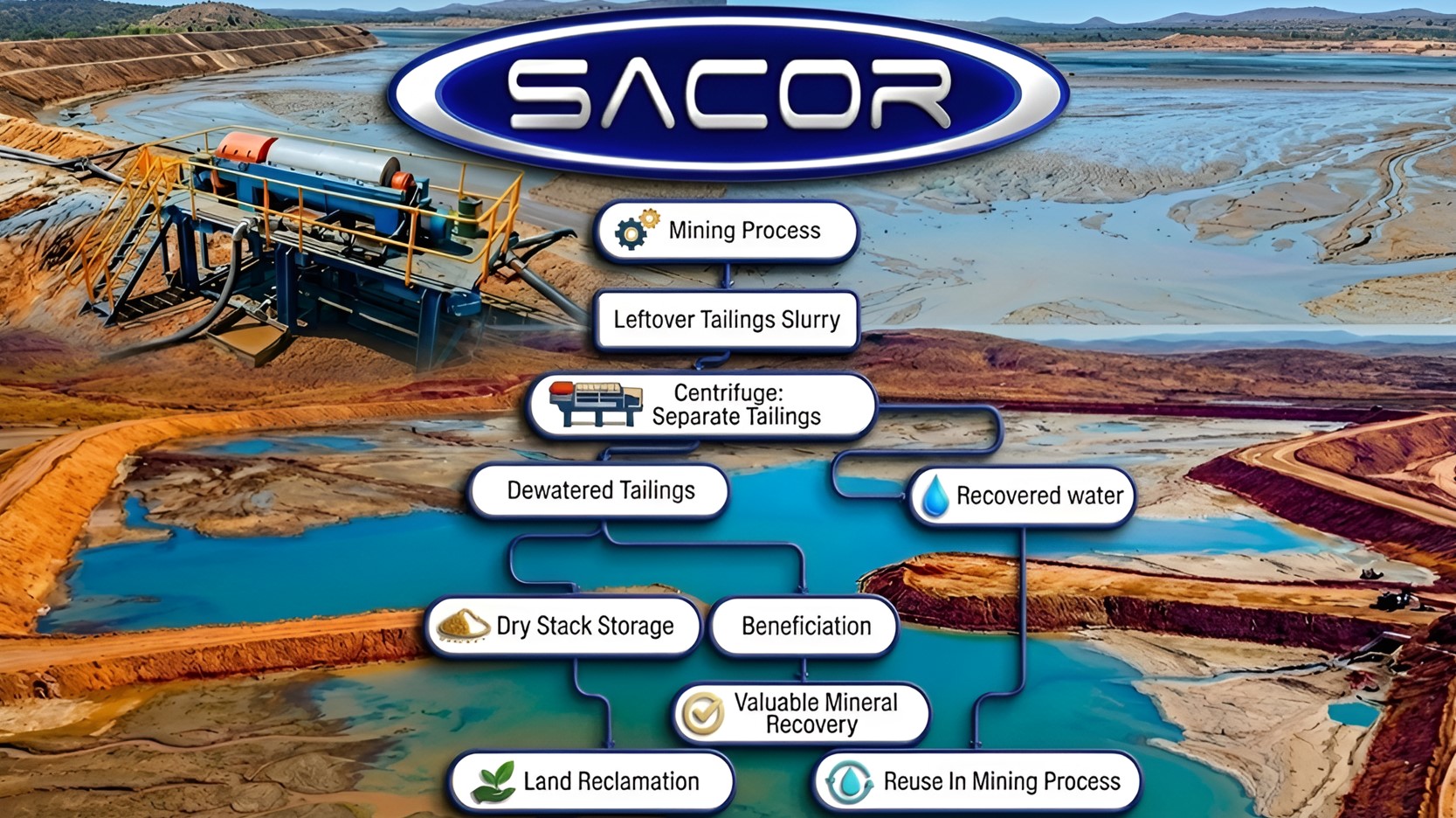
As ore grades decline and processing circuits grow more complex, the ability to efficiently manage tailings has shifted from a routine operational consideration to a central part of plant design. Regulatory frameworks like the Global Industry Standard on Tailings Management are accelerating this shift — but the underlying driver is straightforward: poorly managed tailings cost money, consume water, and create liabilities that compound over the life of a mine.
For Western Australian separation technology specialist Sacor, tailings processing is not a compliance exercise. It is an engineering problem with a measurable, optimisable solution.
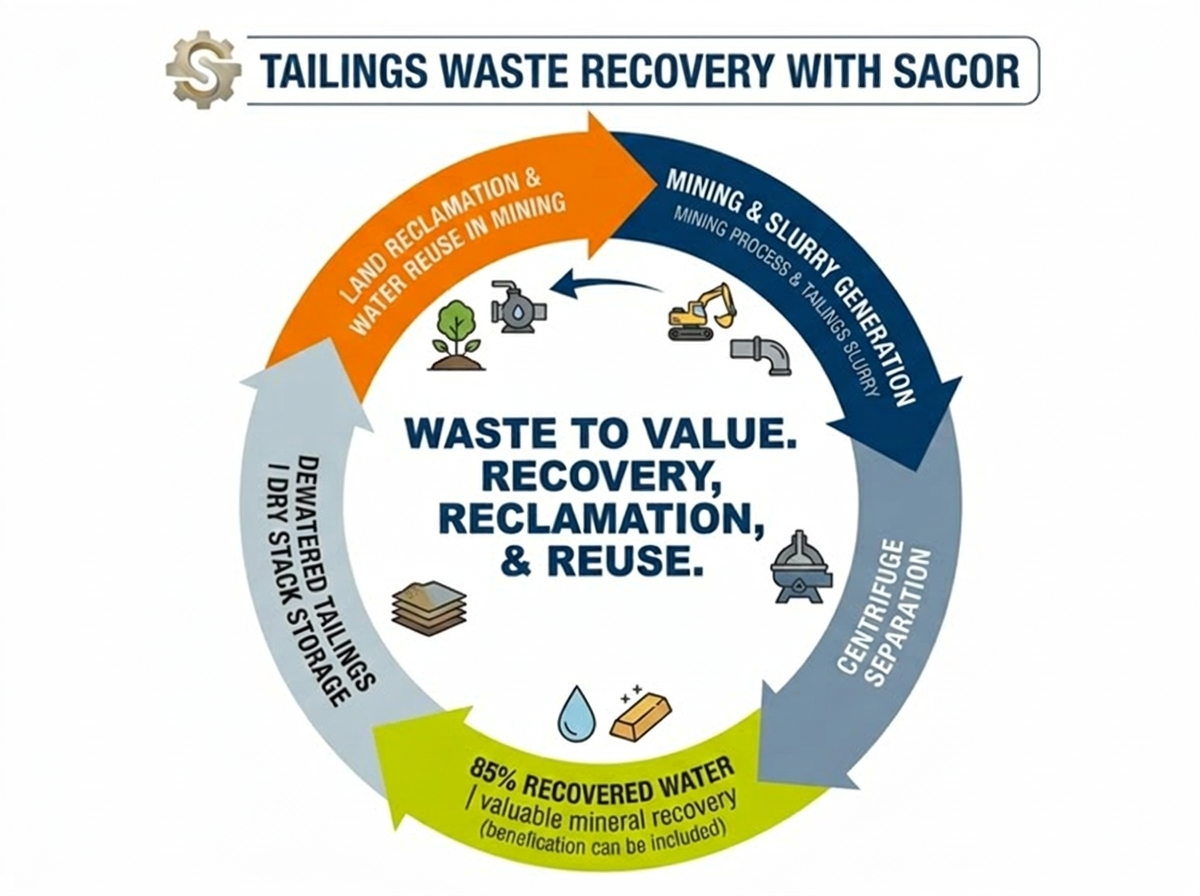
What tailings processing actually involves
After ore is crushed, ground, and processed to extract valuable minerals, the residual stream is a slurry of finely ground rock, water, residual reagents, and trace minerals that must be handled continuously and at high volume. Its physical properties — particle size distribution, clay content, slimes fraction, density, and viscosity — vary significantly between ore types, processing methods, and even different zones within a single deposit.
Managing this variability is the central challenge. A solution engineered for a coarse, free-draining gold tailings stream will perform very differently when applied to a clay-rich base metal slurry or a fine coal refuse circuit. Getting the separation right demands both correct technology selection and a thorough understanding of how the feed material behaves under process conditions.
The centrifuge difference
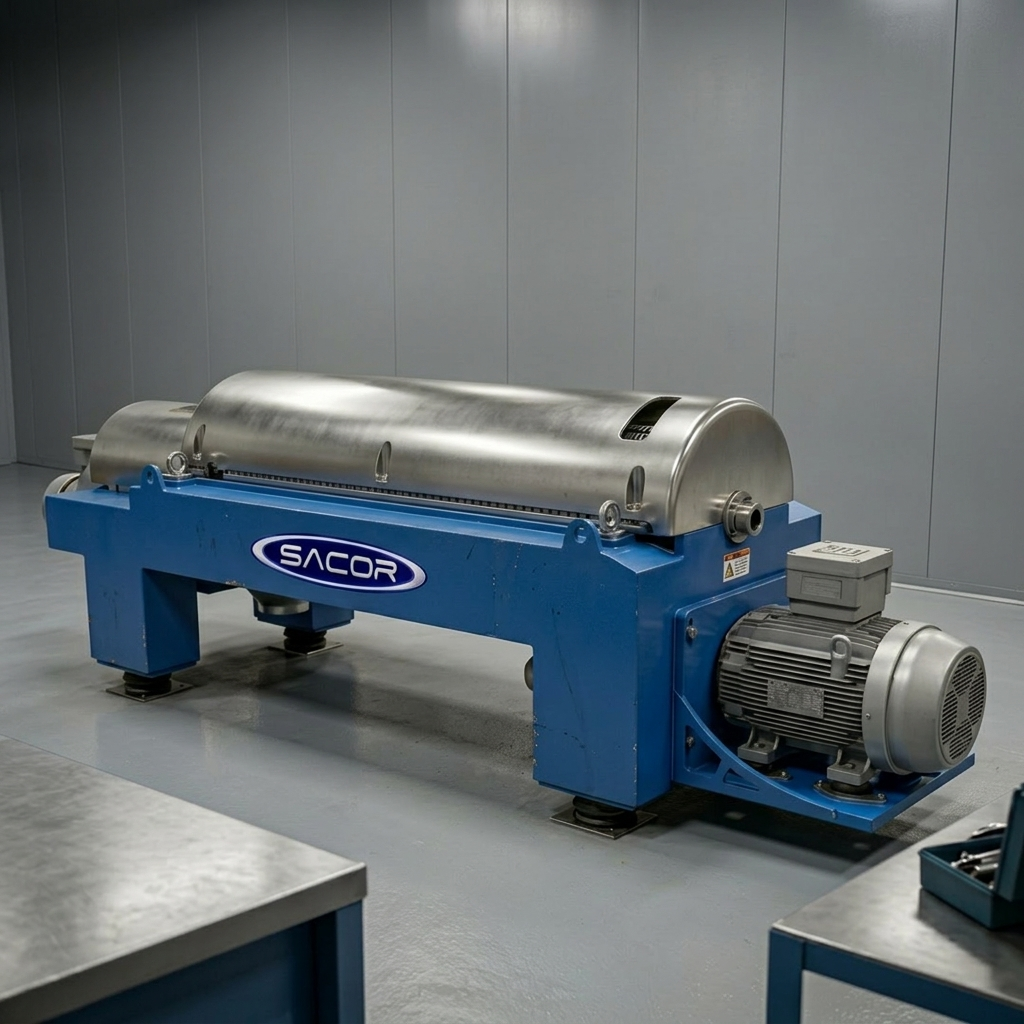
Sacor’s tailings processing capability is built around its SADEC range of two-phase decanter centrifuges and the Delta Canter series of three-phase machines. Both operate on a fundamentally different principle to conventional filtration or thickening.
Feed slurry enters a horizontal cylindrical bowl rotating at high speed, generating centrifugal forces up to 3,500G. Solid particles, being denser, migrate to the bowl wall, where an internal screw conveyor transports them toward discharge. The clarified liquid phase overflows continuously at the opposite end. The entire process runs without interruption, without consumable filter media, and without the process pauses required by batch filtration equipment.
The result: a continuous output of dewatered solids and recovered liquid. Recovered water returns directly to the processing circuit, reducing freshwater draw and reagent consumption. Dewatered solids exit in a form that handles, transports, and stacks far more predictably than wet slurry.
Engineering flexibility across feed conditions
What distinguishes centrifuge-based separation is the degree of process control available to the operator. Bowl speed, pond depth, conveyor differential speed, feed rate, and flocculation chemistry can each be independently adjusted to tune performance to the specific feed material in play.
Bowl speed governs the applied G-force and directly influences fine particle separation and solids dryness. Pond depth controls liquid residence time inside the rotating bowl and overflow clarity. Conveyor differential speed determines how quickly solids are transported to discharge, affecting both cake dryness and liquid phase quality. Combined with appropriate flocculant selection and dosing, these parameters give process engineers precise control across a wide range of feed compositions and throughput rates.
This adaptability makes the SADEC decanter well suited to dewatering, thickening, classification, and clarification duties. The same machine architecture can be configured to separate coarse and fine fractions, produce a thickened underflow for paste or dry stack applications, or generate a clarified overflow for direct reuse — depending on mineralogy, downstream requirements, and overall circuit design.
Three-phase separation for complex streams
Some processing circuits generate tailings containing two immiscible liquid phases alongside a solid fraction — common in certain hydrometallurgical circuits, oil-associated mineral processing, and base metal flowsheets where organic solvents or process oils are present.
Sacor’s Delta Canter addresses this directly. The three-phase decanter simultaneously separates solids and two distinct liquid phases in a single continuous pass, delivering three clean output streams from one machine. That means fewer vessels, a smaller plant footprint, and fewer process steps — meaningful reductions in both capital and operating cost.
Handling difficult minerals
Certain ore types produce tailings that are inherently resistant to separation. High clay content, elevated slimes fractions, and ultrafine particles below ten microns each cause conventional belt and pressure filters to underperform — fine and clay-rich material blinds filter media and resists drainage.
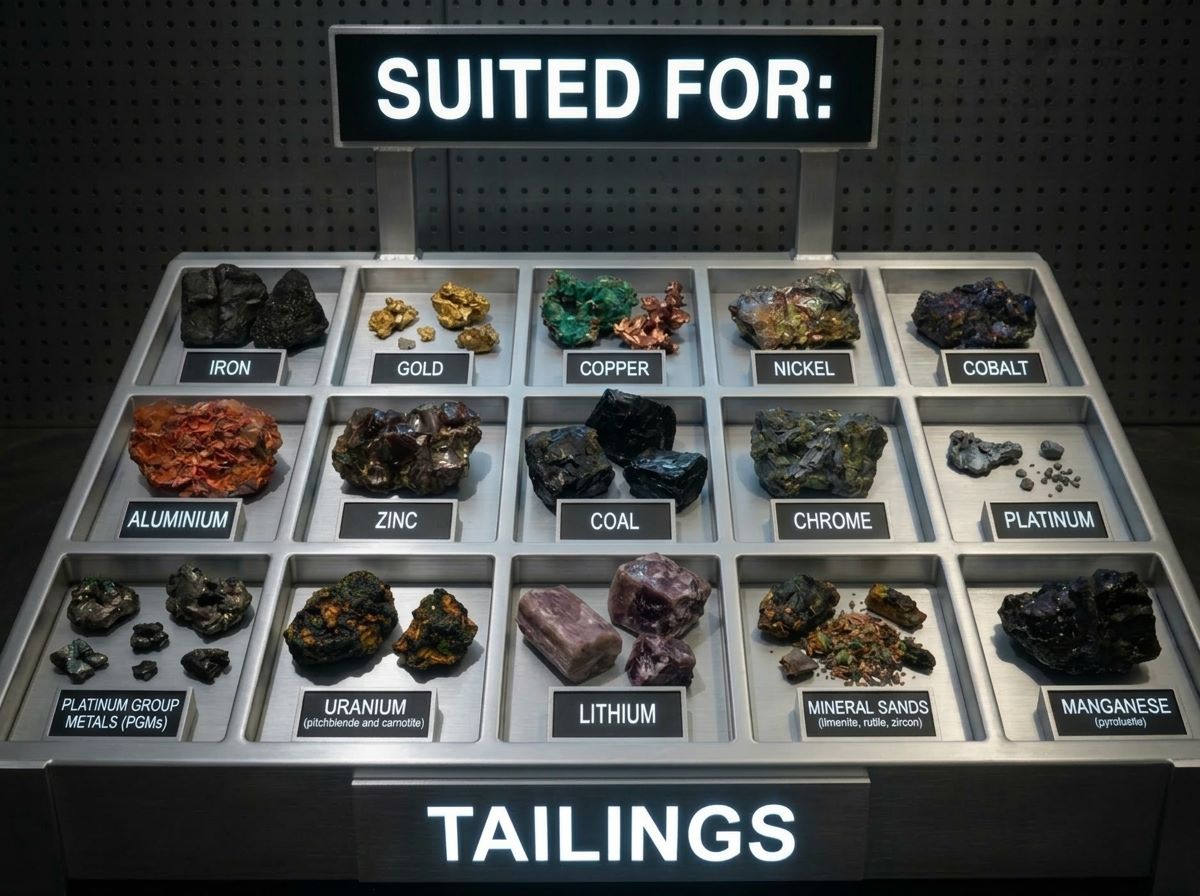
Decanter centrifuges eliminate this problem entirely. There is no cloth to blind, no cake to wash, and no requirement for large volumes of wash water. This makes the technology particularly well suited to gold processing circuits, which frequently produce slimes-rich tailings from fine grinding, and to coal preparation plants dealing with fine coal refuse. In both cases, continuous media-free separation maintains consistent performance regardless of clay or fines content in the feed.
From characterisation to commissioning
Sacor’s engineering team, based south of Perth, works with clients from initial process characterisation through to full-scale commissioning. Feed slurry samples are analysed to establish baseline separation behaviour, and pilot-scale centrifuge trials verify process parameters before full-scale equipment is specified. This upfront work ensures the centrifuge configuration delivered to site is already optimised for actual feed conditions.
Ongoing maintenance and refurbishment capability means optimisation continues well beyond commissioning. Wear components, bowl assemblies, scroll flights, and bearing systems are serviced or replaced to maintain separation performance across the full operating life of the machine — an important consideration in high-throughput applications where even minor degradation in efficiency has measurable downstream consequences.
For processing engineers looking to improve water recovery, increase throughput, or manage increasingly complex feed streams — Sacor’s centrifuge technology delivers a proven, flexible, and precisely controllable solution, purpose-built for Australian mineral processing.
Contact
Phone: 1300 74 60 10
Email: solutions@sacor.com.au
Website: www.sacor.com.au