The way Australia’s mining industry manages tailings is undergoing a fundamental shift. Driven by tightening global standards, escalating environmental expectations and the hard economic reality of water scarcity, operators from the Pilbara to the Hunter Valley are re-evaluating how they handle the fine-grained waste that remains after mineral extraction.
At the centre of this transformation is a technology that has been quietly proving itself across coal, gold, copper, nickel and iron ore operations — the solid bowl decanter centrifuge.
For decades, tailings storage facilities (TSFs) have been the default solution — vast engineered dams designed to contain mining waste in slurry form. Australia currently holds an estimated five billion cubic metres of material in TSFs, with roughly four-fifths classified as active.
While the country’s remote mine locations and high engineering standards have helped avoid the catastrophic failures seen overseas, the industry recognises that the status quo carries risk. The 2019 Brumadinho disaster in Brazil, which killed 270 people, triggered a global reckoning that led directly to the Global Industry Standard on Tailings Management (GISTM) — a framework now being adopted by major operators including BHP, Rio Tinto and South32, with ICMM members required to demonstrate conformance across all facilities by August 2025.
GISTM’s 77 requirements push operators toward minimising the volume and hazard potential of stored tailings. For many mines, that means one thing: getting water out of the waste stream before it ever reaches a dam.
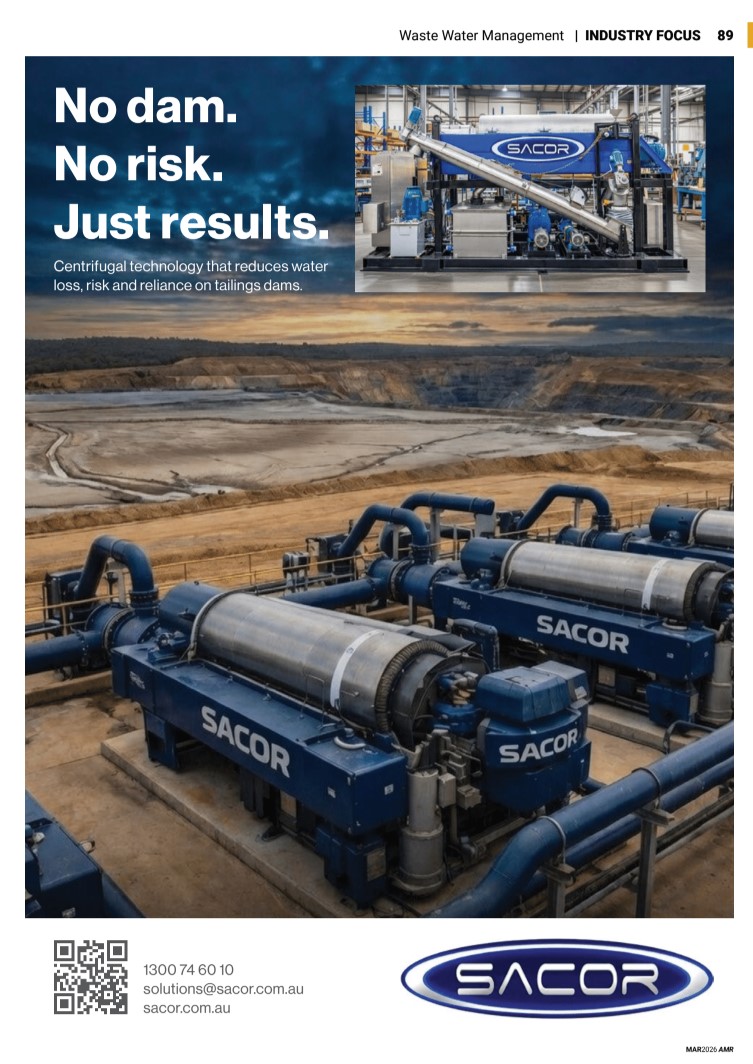
This is where WA separation technology specialist Sacor is delivering a step-change advantage with its SADEC range of two-phase decanter centrifuges and Delta Canter series of three-phase delta-canter centrifuges.
How the technology works
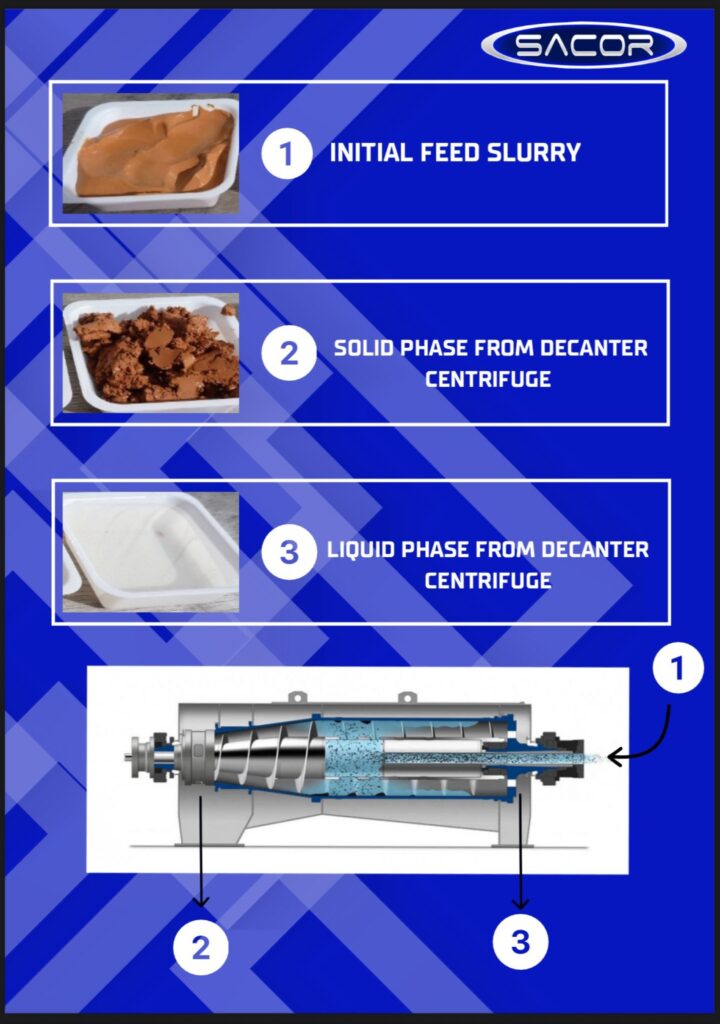
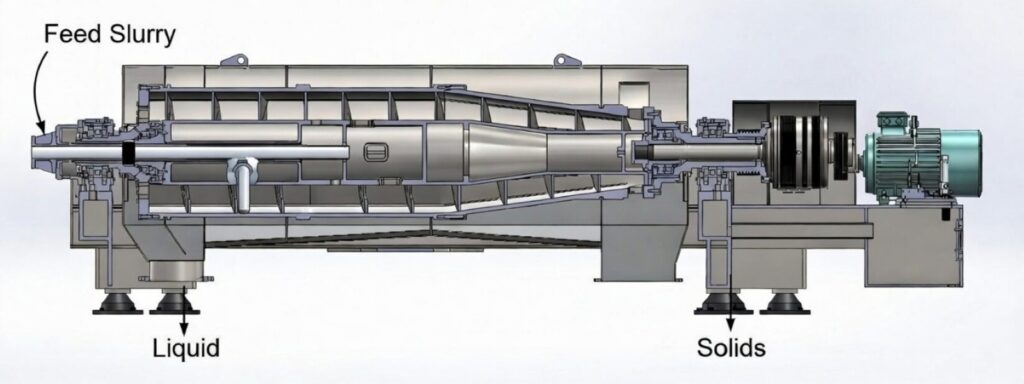
A decanter centrifuge separates solids from liquids using high-speed rotation rather than filtration. Feed slurry enters a horizontal cylindrical bowl spinning at speeds that generate forces of up to 3,500G. The density difference between solid particles and water causes rapid separation — solids are driven to the bowl wall, where a screw conveyor transports them to a discharge point, while clarified water overflows at the opposite end. The result is a firm, spadeable cake suitable for dry stacking or co-disposal, and clean process water ready for reuse.
Sacor’s SADEC two-phase decanters are purpose-configured for dewatering, thickening, classifying or clarifying duties. For operations where the tailings stream contains two immiscible liquid phases alongside solids — common in base metal processing, oil-contaminated slurries and certain hydrometallurgical circuits — the Delta Canter three-phase centrifuge separates all three phases simultaneously in a single continuous process, recovering both liquid streams and discharging dry solids.
Unlike pressure or belt filtration, decanter centrifuges are not defeated by high clay content, slimes, or ultrafine particles below 10 microns. There is no filter cloth to blind or replace, no requirement for large volumes of wash water and continuous operation means fewer interruptions to the processing circuit.
For mines dealing with difficult mineralogies — particularly common across Australian gold and coal operations — this resilience is a decisive advantage.
The water equation
On a continent where water is both scarce and expensive, the ability to recover up to 85% of process water from tailings fundamentally changes the operating economics of a mine. Rather than drawing fresh water from bores or surface sources at significant cost, operators using Sacor’s centrifuge systems can close the loop — returning recovered water directly to the processing plant. For remote operations where every litre carries a logistics premium, the savings compound quickly.
Footprint and flexibility
Space is another factor working in the centrifuge’s favour. A decanter centrifuge installation processing up to 300m3/h, occupies roughly 50m2 of ground — a fraction of the footprint required by equivalent filter press installations. Sacor’s units are available in modular, skid-mounted configurations that can be deployed rapidly for site trials or installed as permanent infrastructure. This portability makes them well suited to operations where TSFs are nearing capacity and an interim dewatering solution is needed while longer-term plans are developed.
Beyond dewatering: mineral recovery from tailings
Sacor emphasises recovering value from the waste stream. Mine tailings often contain economically significant quantities of minerals that were not captured during primary processing. Sacor’s centrifuge systems are engineered to separate and recover these residual minerals — including fine gold, copper, tellurium and platinum group metals — turning what was previously a liability into a potential revenue stream. The Delta Canter centrifuge is particularly suited to these complex separation duties where multiple valuable phases need to be isolated in a single pass.
A tailored approach
Based South of Perth, WA, Sacor’s team of engineers works directly with mining clients to design centrifuge solutions matched to the specific mineralogy, throughput and site conditions of each operation. From initial slurry characterisation and pilot trials through to full-scale installation, commissioning and ongoing maintenance and refurbishment, Sacor provides end-to-end capability backed by an international portfolio of patents in decanter centrifuge design.
With the regulatory landscape tightening, water costs rising and community expectations growing, the business case for centrifuge-based tailings management has never been stronger. For Australian mining operators seeking a smarter, safer and more sustainable approach to their tailings challenge, Sacor offers the technology and expertise to make it happen.
Australia’s mines are moving beyond tailings dams — and Sacor’s advanced centrifuge solutions are leading the way.
Sacor’s decanter centrifuges separate fine tailings into stackable dry cake and reusable process water, recovering up to 85% of water for return to your plant — while also recovering valuable minerals from the waste stream.