A future without Mount Isa
North-west Queensland’s outlook
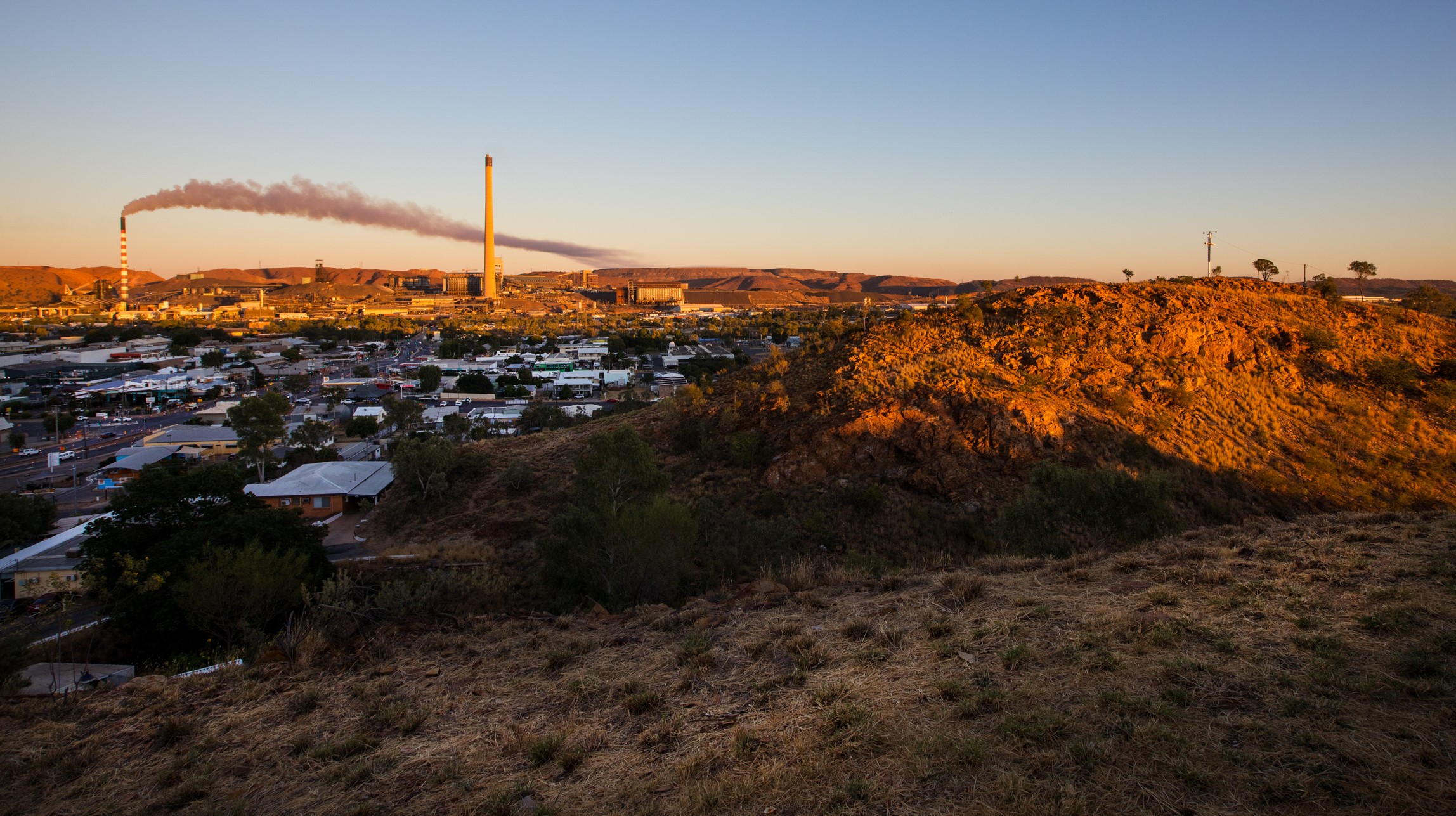
North-west Queensland was rocked when Glencore closed the doors at its Mount Isa mine mid last year.
Depleting deposits and aging infrastructure at the more than 70-year-old site brought the region’s future into question — leaving thousands of workers in the lurch.
Cloncurry Mayor Greg Campbell says the outlook for Mount Isa has been reasonably dire over the last couple of years.
“With the announcement and then the actual cessation of mining at Mount Isa, as well as the uncertainty around the future of the copper smelter itself, there has been flow on that affects the whole supply chain and our communities,” he said.
While the closure sent shockwaves through the surrounding community, the north-west isn’t the Mount Isa-only base-metals story it was 20 years ago.
With extensive copper, gold and critical minerals deposits, the region is experiencing a significant revitalisation of its mining sector and has re-established itself as one Australia’s most important resource jurisdictions.
A contentious history
Mount Isa is not the first north-west operation Glencore has fumbled. In 2022, Evolution Mining (ASX: EVN) acquired full ownership of the Ernest Henry copper-gold-silver project, about 40km north-east of Cloncurry — a project previously deemed unprofitable.
Under this new ownership, Evolution reported record profits from the project and delivered significant returns and reinvestment in the local economy. With a life of mine until at least 2040 and substantial production capacity, Ernest Henry is now a long-life asset with significant growth potential.
The success of the new operators added fuel to long-standing concerns about Glencore’s stewardship of Australia’s copper assets, especially in the north-west region.
“Ernest Henry has been a solid foundation to Cloncurry, and the northwest more broadly,” Mayor Campbell said.
“Evolution saw value and opportunity there and very quickly they’ve seen really great returns come very quickly, which has helped make the decision for them to extend the life of mine and to dig deeper.
“It shows how important the Cloncurry area is and that just because global majors may not see value right in front of their face, does not mean a project cannot generate phenomenal return for shareholders.
“I think it shows that Glencore, from the outside looking in, had no interest in the future of Ernest Henry, that’s why they put it up for sale.”
Billion-dollar copper industry
Located about 95km northeast of Mount Isa in the shire of Cloncurry, the $2.4b Eva copper project received government greenlights in November last year.
Though Glencore may be losing its faith, South Africa’s largest gold producer, Harmony Gold, saw the potential of the regions copper future and acquired the site in 2022.
Harmony chief development officer Johannes Van Heerden said an economic impact analysis reflected mine commencement consistent with the Queensland Government’s Mount Isa mining acceleration program which was designed to protect jobs and businesses in Mount Isa.
“The project will be critical for the north-west minerals province (NWMP) and provides a huge potential uplift for the Queensland economy,” he said.
“The report shows that the Eva project has the potential to deliver substantial economic stimulus, create jobs in Queensland and, importantly, help to supply copper concentrate to the Mount Isa copper smelter and Townsville refinery.”
Expected to produce about 60,000tpa of copper concentrate and 19,000oz of gold over its estimated 15-year mine life, the Eva project will be a major driver of economic growth.
Forecast to inject more than $17b into Queensland’s economy, first copper concentrate is expected to be delivered to the Mount Isa smelter in 2028.
“I don’t think it’s an understatement to say that the future of Mount Isa totally depends on Cloncurry [and the Eva project], because that’s where the solid copper production is going to come out of the ground for the mid to longer term,” Mayor Campbell said.
Emerging critical minerals
Copper may form the backbone of the north-west’s mining industry, but the region is home to about 75% of the state’s base metal and mineral resources.
The north-west is ushering in a new generation of projects, including nickel, phosphate, silica and critical minerals developments
The region holds almost 30% of the world’s vanadium resources and several projects are currently advancing towards production. One notable operation is Critical Minerals Group’s (ASX: CMG) Linfield project, expected to be able to produce around 10,500tpa of vanadium pentoxide.
CMG hopes to also develop a manufacturing plant to produce vanadium electrolyte — an integral element found in high-storage batteries.
Australia has the second largest resources of cobalt in the world and Queensland, mostly in the north-west, holds about 14% of these resources, according to the Queensland Government.
Rarely mined on its own, cobalt is often produced as a byproduct of copper and nickel. Queensland has a well-established copper industry; however, cobalt byproducts are currently not recovered and ends up in copper mine tailings.
True North Copper (ASX: TNC) is one company investigating the potential of dual-extraction mines with its Cloncurry and Mt Oxide projects. The company is currently in the exploration and development stage of its projects with an exploration campaign to expand its geological understanding of the Aquila discovery within the Mt Oxide project underway.
Regional jobs outlook
The evolving resources market is an enormous opportunity for the state of Queensland. According to AREEA, copper and silica projects alone are forecast to generate about 1230 new jobs in Queensland this decade, led by projects in the north-west including Ernest Henry and supported by new developments like Eva.
Projects in and around the north-west minerals province (NWMP) will play a significant part in the economic future of the community. AREEA’s Resources and Energy Workforce Forecast 2025-2030 shows Queensland has 17 major projects in the pipeline needing more than 4,400 extra workers by 2030, with copper and other critical minerals accounting for a growing share of that pipeline.
AREEA industry and advisory director Tom Reid says as well as the typical hands-on technical roles, the critical minerals boom, advanced processing, automation, digital systems and ESG expectations will require a workforce with advanced environmental and data skills.
“With the right transition pathways, world-class skills already in those regions related to heavy machinery, electrical trades, engineering, safety and geoscience can be transitioned over time from coal to copper and critical minerals jobs, so that know-how doesn’t leave town,” he said.
“Developments like Eva and the continued life of Ernest Henry are exactly the sort of projects that can absorb the skills coming out of Mount Isa, such as operators, electricians, engineers and safety specialists.
“These workers should be redeployed into new growth opportunities within our sector, not lost to other industries or other countries.
“However, new projects are not a like-for-like replacement unless policy settings actively support them.
“If Queensland wants new projects to land in Mount Isa’s backyard rather than offshore, governments must prioritise competitive taxation, efficient regulation and practical workforce and migration policies that allow employers to access and train the skilled workers they need.”
Reforming policy and facilitating growth
The north-west minerals province already supports more than 3300 direct workers and injects about $1.4b a year into local communities, according to AREEA
“What we’re seeing now is a new generation of projects, where modern copper, nickel, phosphate and silica developments are more capital-efficient and more automated, coupled with a dramatic workforce shift where remote operations, data analytics and advanced exploration are now standard practice,” Mr Reid said.
“The recent $600m lifeline from the Federal and state governments for the Mount Isa Copper Smelter and Townsville Refinery is also an important, short-term measure, buying these communities three years of sovereign copper processing capability and protecting hundreds of jobs.
“While it’s welcome, it doesn’t solve the hard reality that investors are comparing Queensland’s royalty regime, approvals timelines, energy costs and IR settings with competing jurisdictions every single day.
“If policy settings aren’t competitive, new projects and the jobs that go with them will ultimately leave.”
Queensland Natural Resources and Mines Minister Dale Last says Queensland has the potential to support an increase in global demands of copper and other critical minerals that are increasingly important for advanced manufacturing and emerging technologies.
“Through the Resources Cabinet Committee, the [Queensland] Government is advancing projects like the Eva Copper Mine through streamlined regulatory processes and fostering policies that encourage investment in all resource commodities,” he said.
“These initiatives are vital for Queensland’s economic future and global competitiveness.
“With an endowment of critical minerals, north-west Queensland is well positioned to adapt to global trends and shifting trade dynamics, ensuring the region remains a vital contributor to the state’s economy.”
Shifting the energy paradigm
The state of Queensland produces some of the best quality metallurgical coal in the world, but the global green transition is shifting Australia’s consumption of coal for power generation.
The Australian Energy Market Operator (AEMO) draft 2026 integrated system plan (ISP) confirms that coal will be required to stabilise the National Electricity Market (NEM) until 2049 — twelve years longer than previously forecast.
“Queensland doesn’t have the luxury of pretending it can switch off coal tomorrow and hope everything somehow still works,” Mr Reid said.
“Coal and gas will be needed for decades yet to keep the lights on, keep industry running and keep regional Queensland working.”
The AEMO expects electricity consumption to nearly double by 2050, driven by electrification of transport, expansion of data centres and industry shifting from coal-fire and gas to electricity.
Electricity supply and cost remain a critical risk to investment in the NWMP.
Harmony noted, in its FY25 annual results, that finalising the Eva project’s long-term power supply solution remains a key outstanding element of its feasibility study update.
As part of a move to increase investor confidence in the region, Queensland Government owned PowerLink is developing the CopperString 2032 project. CopperString will build an initial 840km new electricity transmission line from just south of Townsville in the Burdekin region to Mount Isa that will connect Queensland’s NWMP to the national electricity grid — securing affordable energy supply to the region.
The north-west is evolving from a one-town, one-mine operation into a diversified, globally significant mining jurisdiction — one that will support Australia’s economy and regional communities for decades to come.