Where Is Your Gold Plant Giving Away Margin?
A practical look at the small processing losses that can quietly cost tonnes, ounces and operating margin.
By Krutik Parikh, Director & Metallurgist, Liberate Metallurgy
A gold plant can be making budget and still be giving away margin every day.
The losses are often not dramatic enough to trigger a major investigation. A slightly coarser grind. A little more cyanide. Carbon activity slowly declining. Detox reagent creeping upward. Recovery moving by fractions of a percentage point.
Individually, each issue can look small. Across a year, they can become significant.
Look at the plant as one value chain
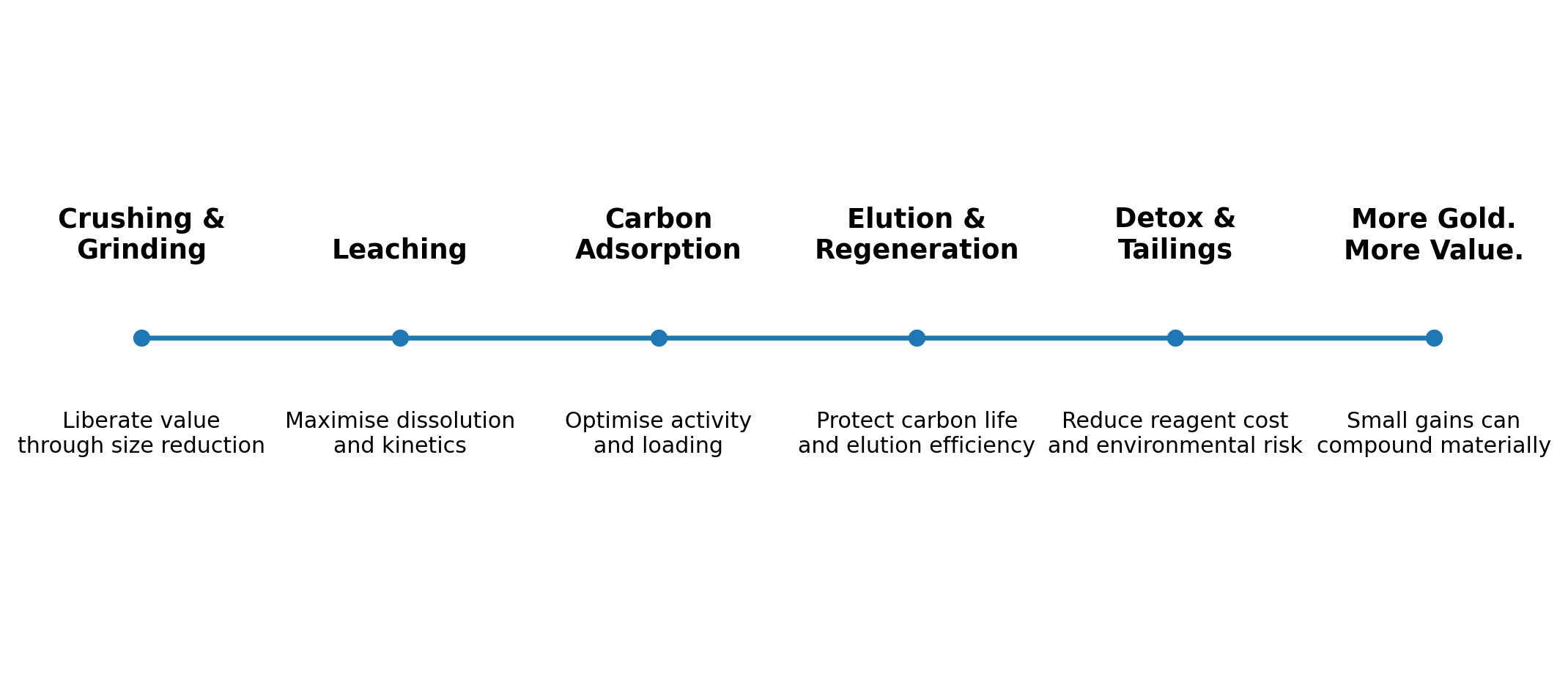
Grinding affects liberation and leach response. Leaching determines how much gold enters solution. Carbon determines how effectively that dissolved gold is captured. Elution and regeneration affect carbon performance. Detox and tailings determine part of the downstream operating cost and risk.
Optimising one area without understanding the next can simply move the cost somewhere else.
Grinding: tonnes versus recovery
The target should not be maximum throughput or the finest possible P80. It should be the best economic balance between tonnes, grind, power, media consumption and recovery.
If pushing another 20 t/h creates a recovery penalty worth more than the additional tonnes, the plant has not really improved. The opposite is also true: over-grinding can consume power and media while unnecessarily constraining production.
Leach and carbon: follow the gold
Instead of asking only whether cyanide or carbon concentration is on target, ask where dissolution is occurring, where adsorption is weakening and where gold is leaving the circuit.
Tank profiles, dissolved oxygen, cyanide, carbon activity, loading and solution losses can quickly show whether the plant has a chemistry problem, a carbon-management problem, a grind problem — or a combination.
Reagents: measure cost against outcome
The cheapest reagent per litre is not always the cheapest reagent per ounce.
A good plant trial establishes the baseline first and agrees on the success measure: recovery, consumption, dollars per tonne, compliance margin or process stability. Procurement, operations and metallurgy can then judge the product against the same outcome.
Put small improvements into dollars
A 0.5 percentage-point recovery improvement can sound minor. On a 1.5 Mtpa plant at 1.5 g/t head grade, it represents roughly 362 additional ounces per year before allowing for plant availability and variability.
That does not mean every plant can recover another 0.5%. It shows why small, repeatable metallurgical improvements deserve proper investigation.
A simple operating framework
The most useful optimisation program is easy to explain:
Find the loss ? quantify the value ? trial the change ? verify the result ? sustain it.
Liberate Metallurgy applies this approach across grinding, CIL, carbon, reagents, detox, troubleshooting and plant optimisation.
For a General Manager, the outcome should be clearer priorities and measurable value. For a Metallurgy Manager, it should create evidence and a disciplined improvement pipeline. For operations, it should result in practical changes that can actually be run on shift.
Small improvements matter when they survive the plant and keep delivering every day.