Your Plant Is Making Tonnes. But Is It Making the Right Tonnes?
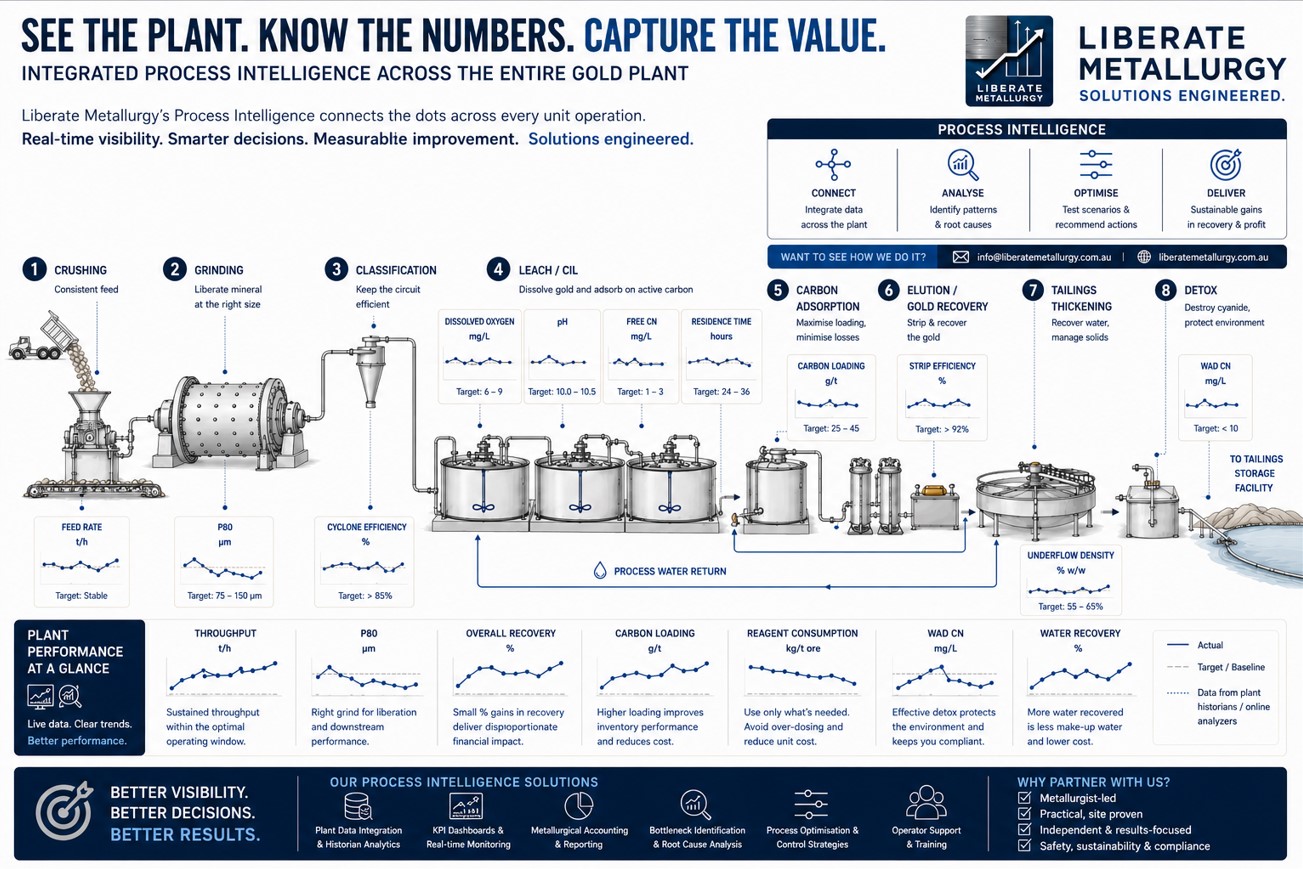
A metallurgist’s view of the hidden interactions between grind, leach, carbon and operating value.
By Krutik Parikh, Director & Metallurgist, Liberate Metallurgy
A processing plant can be running at nameplate throughput and still be underperforming metallurgically.
That is because tonnes alone do not tell us whether the plant is creating maximum value. The real question is what happens to those tonnes as they move through grinding, leaching, adsorption and recovery.
Consider a gold grinding circuit. Increasing mill feed from 180 t/h to 200 t/h looks like a win. But if cyclone overflow P80 moves from 106 µm to 125 µm, liberation may deteriorate. If that coarser product then reduces leach extraction by even a fraction of a percentage point, the additional throughput needs to be compared against the gold being lost to tails.
The optimum operating point is therefore not maximum throughput. It is the point where **throughput × recovery × value** is maximised while power, grinding media and downstream constraints remain acceptable.
The same principle applies in CIL. A recovery drop should not automatically trigger more cyanide.
A metallurgist should first ask: Has the grind changed? Is dissolved oxygen limiting leach kinetics? Is free cyanide adequate through the tank profile? Has residence time reduced? Is carbon activity declining? Are soluble losses increasing, or is the loss predominantly solid?
These questions matter because the same final tails grade can have very different root causes — and therefore very different solutions.
Carbon performance is another common example. Maintaining the required carbon concentration does not guarantee good adsorption. Carbon activity, loading, fouling, attrition, regeneration performance and interstage movement all influence soluble gold losses.
Likewise, increasing reagent dosage can sometimes hide the real process constraint rather than solve it. The technically correct question is not ‘how much reagent are we adding?’ but what incremental metallurgical benefit are we receiving from the next unit of reagent?’
This is where historical operating data becomes particularly valuable. Plants already record mill power, feed rate, density, cyclone pressure, P80, dissolved oxygen, cyanide, carbon data, assays, reagent consumption and downtime.
When these variables are analysed together — with metallurgical context — patterns begin to emerge. Which operating window consistently produces the best recovery? At what throughput does P80 become unstable? When does additional cyanide stop improving extraction? Does declining carbon activity correlate with increasing soluble tails?
At Liberate Metallurgy, this thinking sits behind our GrindScope™ and CILScope™ Process Intelligence approach. The aim is not to replace the plant metallurgist with software. It is to help metallurgists and operations teams interrogate more operating data, identify the variables that genuinely matter and focus plant trials where the economic upside is strongest.
For management, the output should ultimately be simple:
What are we losing? Why are we losing it? What is it worth? What should we change — and did the change work?
That is the bridge between metallurgical optimisation and business performance.
A well-run plant does not simply make more tonnes. It makes the right tonnes, at the right grind, at the right recovery and at the right cost.
Metallurgist’s plant check
- Is increased throughput changing P80 or downstream recovery?
- Are leach profiles showing where dissolution is actually occurring?
- Are cyanide and oxygen beingoptimisedtogether rather than independently?
- Is carbon activitybeing tracked alongside concentration and loading?
- Are reagent additions being evaluated against incremental metallurgical benefit?
- Can the site quantify its largest recurring loss in ounces or dollars?