Diesel will power Australia’s mines for years to come, but it won’t be the only fuel on site for much longer.
Emissions regulations, renewable diesel trials, rising AdBlue consumption, electrification and hydrogen pilots along with the steady expansion of lubricant storage are reshaping what a modern mine site fuel farm looks like. Where as diesel once did most of the work, operators now need to store, separate and dispense multiple hydrocarbons safely whilst wanting full visibility on every litre used.
A diversifying fuel landscape
Several trends are driving the change.
AdBlue or diesel exhaust fluid is already part of the conversation around refuelling with mining fleets adopting selective catalytic reduction (SCR) engines at pace. Storing AdBlue requires dedicated, contamination-free tanks: the fluid is sensitive to heat and sunlight, and any cross-contact with diesel renders a batch unusable.
Renewable diesel and in particular hydrotreated vegetable oil (HVO) is being trialled by major operators as a direct drop-in replacement for conventional diesel. It burns cleaner, reduces Scope 1 emissions, and doesn’t require new engines. It’s a lot more stable than diesel with a longer shelf life in storage without the use of additives.
Aviation fuel storage is also growing as more remote operations run their own FIFO airstrips, and sustainable aviation fuel (SAF) will eventually enter that mix too.
Electrification sits alongside all of this. Battery-electric haul trucks, electric locomotives and on-site fast-charging infrastructure are being deployed at pace by miners including Fortescue and BHP. But electrification doesn’t eliminate on-site liquid storage, it reshapes it.
Standby generators, ancillary fleets, light vehicles and aviation operations continue to run on diesel, and electric drivetrains bring their own fluid requirements, from specialised gear oils to battery thermal management coolants. A hybrid mine site will need more seperation between fluids, not less.
And of course Hydrogen, a fuel source still in development. Hydrogen storage is a fundamentally different category of infrastructure to tradional fuel storage. Be it high-pressure or cryogenic processing, it has its own safety envelope and materials requirements. But like the other fuels already mentioned, hydrogen will sit alongside other liquid fuels on mine sites rather than replace them.
Fuel first, lubricants second. Mining is a highly mechanical process and irrelevant of the fuel source, lubricants play a big part in ensuring components are well oiled and keep moving. Demand to scale up and streamline operations has operators storing lubrcants in far higher volumes on site.
A testiment to this surge in demand is Viva Energy’s new lubricant storage facility in Karratha. 14 aboveground storage tanks delivering 2.4 million litres of storage and dispensing across ten different grades of lubricants. It’s the kind of project that would have been almost unthinkable a decade ago.
Modular storage for a moving target
The challenge for Australian mine operators is that no one is entirely sure what the energy mix will look like over the next 10 years. That makes committing to fixed, in-ground infrastructure a risky capital decision.
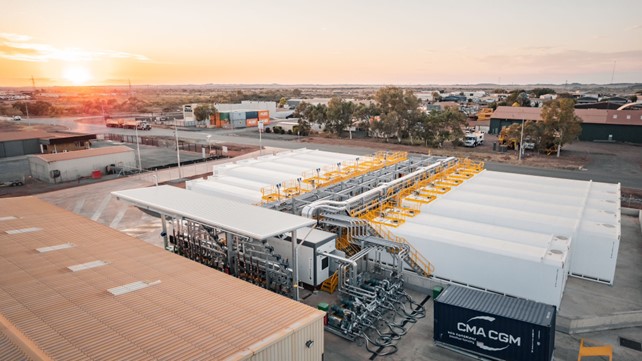
This is where F.E.S. TANKS self-bunded, aboveground modular storage has become the format of choice. Their range spans from 1,000-litre BLOC cube tanks through to 110,000-litre GRANDE aboveground tanks, with dedicated variants for AdBlue, aviation fuel, waste oil and the four-hour fire-rated SHIELD range. Tanks can be linked to form bulk fuel farms, seperated by fuel type, and relocated as site requirements change.
F.E.S. TANKS Director Daryl Cygler said the shift is already visible across the company’s order book.
“The mine site fuel farm is no longer a single-fuel facility. We’re designing for a mix.”
Mr Cygler said. “Our job is to make sure the storage is ready for it.”
“The advantage of modular self-bunded storage is that it adapts with the mine.”
“If the operation scales up, you add tanks. If the plan changes, if a new fuel comes online, if the site has other priorites, the infrastructure adapts. You’re not locked into decisions made five years earlier.”
All F.E.S. tanks are engineered to Australian Standards AS1940 and AS 1692 for the storage and handling of flammable and combustible liquids, and every unit carries a 10-year structural warranty.
Located in Cairns and having a distribution network covering Darwin, Brisbane, Sydney, Melbourne, Tasmania, Adelaide and Perth, the company is positioned to support operators wherever the next project, and the next fuel type turns up.
F.E.S. TANKS is a leading provider of high-quality, self-bunded fuel storage tanks and versatile refuelling solutions to industries on the move. They also specialise in tank farms and custom-built projects for all types of hydrocarbon storage
For more information go to www.festanks.com.au