The next era of mining
Decision support where work actually happens
For all the progress the mining industry has made in digitisation, one bottleneck still slows every site, the gap between collected data and the decisions made on the ground. Fleet Management Systems (FMS) have delivered tremendous value as operational tracking tools, but they were never built to provide the deep context required for real-time decision support or practical automation.
That capability requires a different foundation entirely, one built on high-resolution, consistently labelled, context-rich data.
MaxMine has spent nine years assembling exactly that foundation, with more than 12 million hours of second-by-second, sensor-level machine data, cleaned, quality checked and automatically classified across all major equipment types.
This dataset, and the infrastructure supporting it, gives mines a level of operational context that simply hasn’t existed before.
It means mines can finally move beyond reporting what happened and start reliably understanding why events occurred, whether it’s queuing behaviour, road conditions, operator variability, circuit design, haul speed changes or mechanical performance signals that conventional systems may downsample or miss entirely.
MaxMine chief executive Shaun Mitchell says the challenges with traditional FMS is that they tend to have less detailed data.
“We take data directly from sensors and the benefit is quite profound,” he said.
But the real breakthrough isn’t just the quality of the data, it’s where the insight now goes.
“We get second-by-second data and we classify and automatically label it, meaning there is less human intervention and faster turnaround,” Mr Mitchell said.
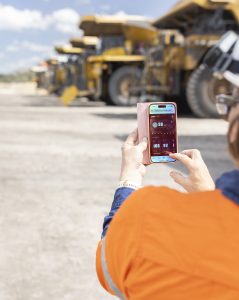
MaxMine has re-designed the decision-making loop so supervisors, operators, dispatchers and engineers don’t have to sift through dashboards or wait for meetings. Instead, they receive mobile-first, push-notification insights that surface:
- Specific actions needed to hit the shift plan
- Variances in operator behaviour with targeted coaching prompts
- Road or circuit conditions impacting productivity
- Equipment health and performance indicators
- Safety-related deviations in real time
In other words, decision support where decisions actually happen, in the pit, on the ramp and in the cab.
This change also lays the groundwork for practical AI in mining. MaxMine’s labelled sensor data, automated classification and context layers feed AI models that synthesise reports, predict constraints, flag emerging risks and generate role-specific recommendations at the start of each shift.
The result is an operation that can adapt faster, eliminate variability and sustain improvements, not through more reports, but through timely, high-clarity prompts that help frontline teams consistently meet their budget.
“When we’re doing that automatically, that gives us something that the FMS can’t do, and that’s context,” Mr Mitchell said.
“FMS will tell you that there has been idle time or hang time. What it can’t tell you is why.
“That’s the big change we’re bringing, but we’re taking that a step further now and saying that with that extra bit of data in that context about what the problem is and why it’s happening, is that we can then offer solutions.”
FMS gives you oversight, MaxMine gives you outcomes
MaxMine connects operator behaviour, machine response, and real-world context, exposing the root causes behind every incident and driving the behaviour change needed for lasting safety improvement.
MaxMine offers two products, Impact and Pulse, designed to improve operations and mine site returns with data to support better intra-shift decision making.
Mining doesn’t need more data, it needs the right data, delivered to the right people, at the right moment.
That’s the step change MaxMine is enabling and it’s happening where it matters most: on the ground, shift by shift.
+61 8 8223 6000
info@maxmine.com.au
www.maxmine.com.au