Mining operations located near the coast face a reliability challenge that is often underestimated — premature failure of motors and alternators due to salt exposure and persistent humidity. From coastal processing plants and ship-loading facilities to offshore infrastructure, rotating electrical equipment operating in marine environments is subjected to conditions far more aggressive than those typically considered in standard industrial designs.
Salt-laden air accelerates corrosion of mechanical components while moisture ingress into windings can degrade insulation systems. Combined with continuous high-speed operation, these factors significantly increase the risk of electrical and mechanical failure. In many marine environments, generator and motor assemblies that would normally operate for extended periods can begin experiencing serious degradation at around 8,000 operating hours.
For mining operators, the consequences extend beyond maintenance costs. Unplanned equipment failures can interrupt production, particularly in remote coastal sites where retrieval, repair or replacement can be complex and expensive.
Why Failures Occur
In high-salinity environments, deterioration occurs on multiple fronts:
- Corrosion weakening rotor components and mechanical fasteners
- Moisture penetration into windings, reducing insulation resistance
- Salt contamination accelerating electrical tracking and dielectric failure
- Continuous operation increasing mechanical fatigue in rotating assemblies
Traditional marine coatings and standard rewinds can provide some protection, but they often address only surface corrosion rather than the underlying structural and insulation vulnerabilities within the machine.
How Haz-Elec Improves Reliability
Haz-Elec works with mining operators and support service providers to improve the durability of motors and alternators operating in harsh coastal and marine environments.
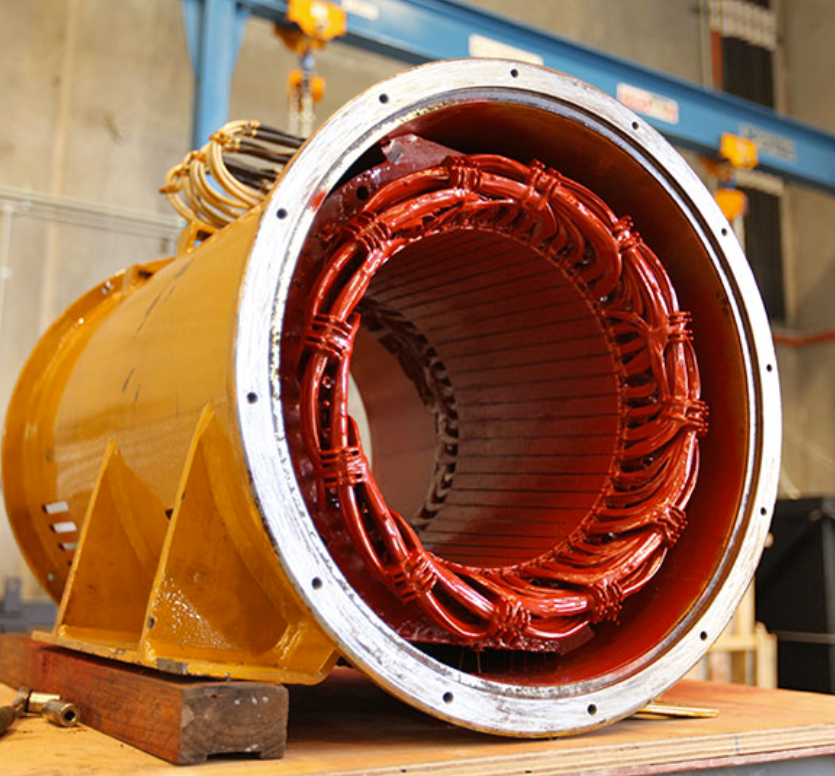
The company’s approach focuses on identifying the root causes of failure and implementing targeted engineering modifications to improve both mechanical and electrical resilience. This includes reinforcing critical rotor components to minimise corrosion-related fatigue, upgrading insulation systems to improve resistance to moisture ingress, and applying enhanced varnish treatments to better protect stator windings from salt exposure.
Haz-Elec also conducts performance monitoring and testing to evaluate vibration, bearing temperatures and insulation integrity, helping operators identify emerging reliability risks before failures occur.
By combining engineering modification, testing and condition monitoring, Haz-Elec helps extend equipment service life, reduce unplanned outages and improve whole-of-life performance for motors and alternators operating in some of the harshest environments in the mining industry.
For mining operators looking to improve reliability in coastal or marine environments, Haz-Elec provides practical engineering solutions designed to keep critical rotating equipment running longer and more reliably.