Why bore pumps fail in mining and what the best sites do differently
A practical look at matching bore pump design to real Australian mining conditions
For most mine sites, groundwater is both a necessity and a challenge. It needs to be controlled, moved and managed constantly to maintain production, support dewatering programs and provide a reliable water supply. Yet bore pumps often operate out of sight, receiving attention only when something goes wrong.
Across Australia’s mining regions, from the Pilbara and Goldfields to Queensland’s coal basins, bore conditions can vary dramatically. Water temperature, salinity, dissolved gases, iron bacteria and sand content all influence whether a pump delivers reliable service or becomes a recurring maintenance problem. Many bores look similar on paper but behave very differently once operating.
The hidden cost of a bore pump failure
When a bore pump fails, retrieval crews, lifting equipment, reduced dewatering capacity, labour and production disruption can quickly cost more than the pump itself. In remote locations, even a routine pull can become a major expense.
Sand changes everything
Sand is a major contributor to premature bore pump wear. Even modest concentrations can erode hydraulic components, bearings and wear surfaces. As clearances increase, efficiency falls and the pump works harder to deliver the same duty.
A standard bore pump may meet the specified flow and head but still be poorly suited to abrasive mine water. In harsher applications, attention needs to go to the areas that wear first. Silicon carbide bearings, wear rings on both the impeller and casing, wear-resistant stage sleeves and sand deflectors can help protect the hydraulic assembly and make servicing more predictable.
Heat is often the real enemy
While sand gets attention, heat can be just as crucial in determining motor life. A submersible motor relies on surrounding water for cooling, so temperature, loading, water velocity and position in the bore all matter.
Some UMA motor configurations can be engineered for shroudless operation, including below-screen installations, but this is not a blanket rule. Water temperature, motor loading, bore geometry and installation position must all be checked before that decision is made.
Standardisation can create a sizing trap
Many mining operations are reducing the number of pump models held on site to simplify spares, training and maintenance. That can make sense, but forcing every bore onto a limited model list can leave some pumps oversized and others undersized.
An oversized unit may need throttling or regular speed reduction and can operate away from its best efficiency range, increasing heat, vibration, recirculation, energy use and wear. An undersized unit may not achieve the required flow or head, forcing it to operate at the far end of its curve where it may overload the motor or encourage cavitation.
Standardise where duties genuinely overlap but verify each bore against its system curve and expected operating range. Fewer models should not mean compromising pump selection.
Material selection is not a tick-box exercise
Flow and head are usually the first numbers considered during pump selection, but they do not describe the fluid being pumped. Salinity, corrosion risk, dissolved gases, iron bacteria and solids can shorten equipment life well before normal wear limits are reached.
Water analysis gives engineers a better basis for selecting stainless steel, duplex stainless steel, seal arrangements, bearings and wear components. The UPA range can be configured with different materials and upgraded components to suit specific conditions, rather than treating every bore as clean water.
Reliability belongs to the whole system
A guided, fast-closing non-return valve can reduce the risk of jamming, valve slam and reverse rotation. Replaceable wear rings can simplify repair, while a motor selected for the pump’s maximum output reduces overload risk. Together, these details remove avoidable failure points.
Efficiency also matters because bore pumps often run for long periods. But the most efficient pump on a test curve is not the lowest-cost solution if it wears quickly or operates outside its intended range.
What Pilbara experience has shown
Pilbara trials highlighted what can happen when the pump package is matched to the bore rather than selected on duty point alone. The recorded challenges included water temperatures up to 35°C, high salinity, iron bacteria, gas content, sand, corrosion and below-screen installation. Previous equipment had experienced motor overheating, seal failures and heavy wear.
The engineered responses included cast stainless steel or duplex construction, upgraded windings, reinforced sealing and thrust-bearing arrangements, wear-resistant components and motors designed around the actual cooling conditions. Trial records reported stable motor temperature and current, longer operating cycles and improved efficiency compared with the previous installations.
Start with the bore, not the catalogue
Reliable groundwater extraction begins with good site information. Confirm the required duty, but also examine water analysis, sand loading, groundwater temperature, drawdown, bore construction, installation depth, operating profile, power supply and control method.
The objective is not to install the biggest pump available or select equipment on capital cost alone. It is to select a complete system that can deliver the required water, operate efficiently and be maintained safely under the conditions it will actually face.
When mines take that approach, bore pumps stop being consumables and become manageable assets. Underground conditions will always be tough. The job is to make sure the equipment sent down the hole is designed for them.
A practical UPA/UMA package for demanding mine bores
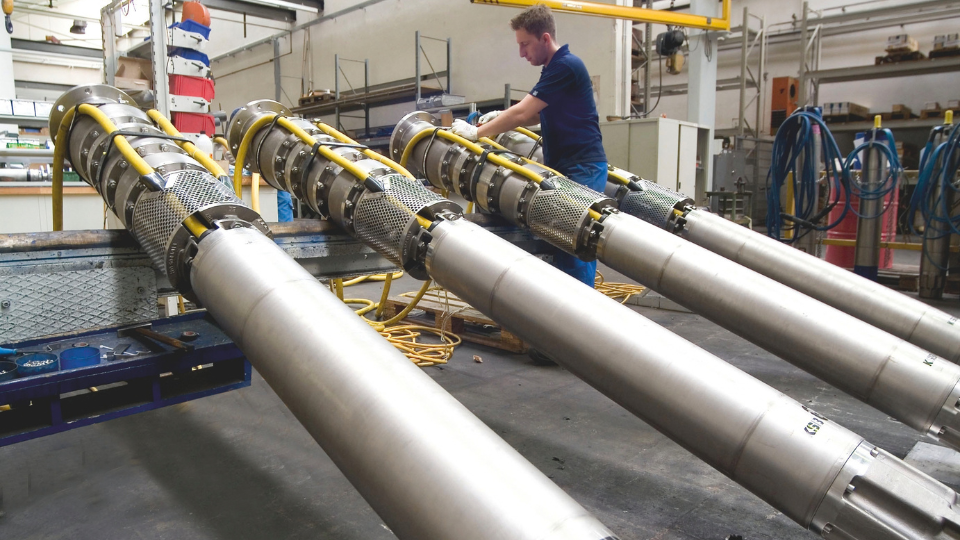
The KSB UPA bore pump and UMA submersible motor range provides a flexible platform for mine dewatering, groundwater control and process-water supply. Single- and multistage configurations, broad hydraulic coverage and vertical or horizontal installation options allow the package to be selected around the bore and its operating duty rather than being forced into a one-size-fits-all approach.
Key benefits for mining applications
- Matched to the duty: optimised hydraulic selections support efficient operation across differing flow, head and bore requirements.
- Built for abrasive water: available integrated sand separation, robust wear rings, enclosed pump bearings and wear-resistant material options help protect critical components.
- Material flexibility: pump and motor configurations can be selected to address salinity, corrosion, temperature and site-specific water chemistry.
- Reliable motor performance: UMA motors are designed for continuous submerged operation, with cooling, loading, installation depth and operating profile considered as part of the overall system design.
- Reduced system risk: anti-jam, fast-closing non-return valve arrangements can help limit blockage, water hammer and reverse rotation.
- Lower whole-of-life cost: efficient hydraulics, serviceable wear components and correctly matched motors can reduce wasted energy, premature wear and avoidable bore pulls.
Planning a new bore, reviewing repeat failures or standardising a site fleet? Bring KSB the duty point, bore construction, water analysis, sand loading, groundwater temperature, installation depth, power supply and operating profile. The UPA/UMA package can then be assessed against the site’s real operating conditions, with the objective of delivering dependable water, practical maintenance and a lower total cost over the life of the asset.