A brief review of gold and drivers through 2026 and beyond
Gold is having an extraordinary year, as the price punched up to all-time highs in January, before a wild and volatile February and then a significant decline between March and August.
What explained the decline in the gold price ‘post-Iran’?
The rise in the price of crude and the US Dollar in response to military strikes in Iran, the closure of the Strait of Hormuz, and the sudden shift in interest rate expectations all pushed gold lower.
Rate expectations changed for two reasons; as the market reappraised, energy shortages effected prices, and because spending on tech kept the American economic locomotive powering on. Of course, inflation was already riding above the Federal Reserve’s mandate as Trump’s tariffs added 1 pct to the underlying inflation number. Therefore, markets took the view that the Fed and other central banks would take a hard line in terms of monetary policy.
The US Dollar rallied in part because it is still a highly liquid haven. It also stemmed from America’s position as a net exporter of oil and oil products, meaning the sharp rise in oil prices drove the currencies of oil-importing countries downward.
Gold’s consolidation
Predictions of mayhem in world crude markets haven’t played out, at least so far, largely as China appeared to run down crude inventory, leading to a sharp reduction in imports. Gold and crude had been distinctly negatively correlated until early May. This relationship reversed course partly as crude prices eased on lower Chinese imports, in hope for a resolution to the Iran crisis. This correlated with gold demand from the official sector rebounding in the second quarter, reaching almost 290 tons.
The Return of the Debasement trade
The Dollar debasement story had been less prominent for the first half of the year. The underlying reasons hadn’t disappeared. Debt only grew, and there were absolutely no signs of fiscal discipline anywhere at all.
However, news flow and asset markets were dominated by conflict in the Gulf. One of the short-term consequences of which was a sharp rally in the US Dollar, for the reasons outlined above.
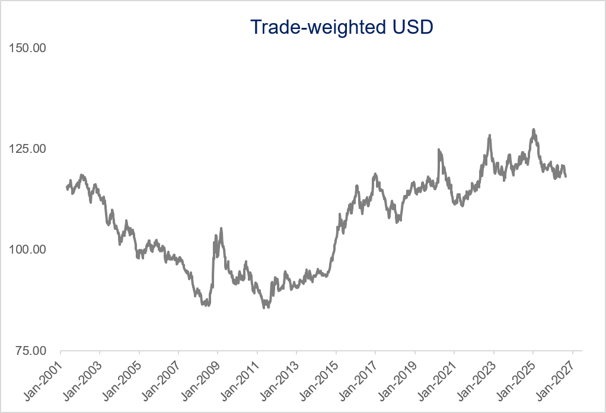
The Dollar is in fact quite highly valued in Trade-weighted terms already, helped by huge levels of net foreign inflows into American assets. This was boosted by the allure of investment in AI.

Initially, the conflict in the Persian Gulf and the rally in the US currency obscured the debasement story, but the alarming lack of a discernible exit ramp and what can only appear as the diminution of American interests. This has led to an inevitable re-assessment of the Dollar’s future path.
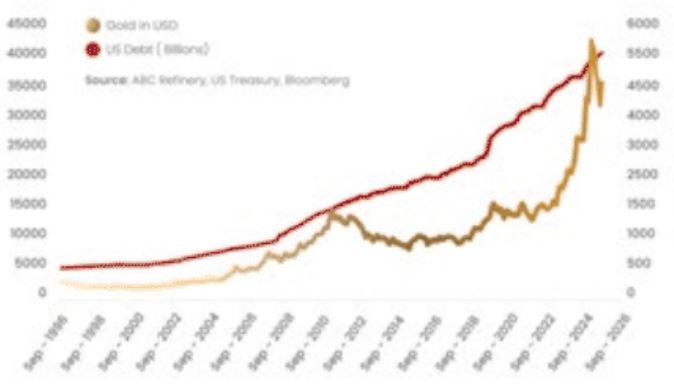
Total US Debt grew from 37.25 trillion US Dollars last August to just over 40 trillion US Dollars this August. 40 trillion has all the additional heft of a ‘round number’, and to add to the alarm is the rate of growth in debt. It is easy to forget that US debt has grown almost four-fold in the last two decades of the Republic alone.
The gold price not climbing as quickly as debt rose in the period 2011-2020 may possibly be attributed to a period of higher real rates either side of very low real rates.
The inexorable growth in debt came into sharp focus in August when US Treasury Secretary Scott Bessent chose to intervene in debt markets.
The apparent trigger for the intervention was fear that US Treasury yields were climbing too far, and yes, touching a two-decade high was clearly worrying.
However, remember there was no obvious crisis, no buyers strike in the US debt auction markets, and there’s no clear rationale for government intervention in the far end of the bond market right now. Aside from the subjective element that ‘yields haven’t been here for 19 years’, and perhaps any motivation for action may largely reflect sensitivities around the upcoming midterm elections.
Now that the treasury has chosen to intervene, the risk is always that a struggle between the clearing price in the free market for bonds and the target that the government seeks, may compel the US Treasury to take even larger and more disruptive policy steps to manage (Some may argue that the post-GFC interventions via ‘Quantitative Easing’ and the subsequent run-off of the Fed’s balance sheet makes talk of a completely free market in US Debt debatable).
Without a long swim through the plumbing of the US Treasury and Federal Reserve system, Bessent’s actions and suggested remedies, such as using the TGA (Treasury General Account) are a short-term fix that may interfere in the policy choices designed to stabilise prices and the labour market, the Fed’s dual mandate.
This chart shows that since the inauguration of President Trump we have had a period of economic uncertainty that outmatched the Covid outbreak in intensity and duration, a factor which has benefitted gold.
Early this year, as gold fell, I said that the very positive backdrop for gold remained in place, even if the market could surprise on the downside. Debt and the lack of institutional will to tackle debt is still the core bull case for gold. Geo-political uncertainty (which in practice often goes in hand with rising debt and economic uncertainty) also provides a tailwind for gold.
And the silence on both sides of the house in America on how to deal with the pressing debt problem adds to the fear that drives investors into gold. It is easy to be glib, but for the most part Republicans have granted their mute assent to the recent tax cuts that have worsened America’s financial outlook, whilst the ‘rent control’ and ‘identitarianism’ arguments offered by the Democrat opposition are pitiful non-substitutes for the hard conversation that America (and other nations) will soon be compelled to have about their taxation and spending choices.
Has the ‘Bessent intervention’ moved that discussion closer, unintentionally?
What about headwinds for gold?
Increasing debt and the competition for funds from technology sector, rising military spend and replacing aging-out infrastructure may all act to drive real rates higher in the push to incentivise savers. Rising real rates tend not to help gold.
Finally
Debt and fiscal profligacy were always the consistent motivator behind gold’s rise, even if other variables stepped in and out of the limelight.
It has only been a surprise in how attention was drawn back to debt, not why, and therefore gold remains a favoured hard asset that helps insure investor portfolios, and until that changes, I remain optimistic about the price outlook.